Why Traditional Call Centers Are Dying (And What's Replacing Them)
Picture this: It's 2015, and you own a contact center. You've invested $500,000 in on-premise hardware. Your team of 50 agents works in a cramped office. You're paying $150/month per employee for phone lines alone. Scaling up? That means more office space, more hardware, more installation fees—months of waiting, hundreds of thousands in investment.
Now jump to 2026.
A competitor with just $5,000 launches a cloud call center. They hire 50 remote agents working from homes across the country. Their monthly telecom costs? $2,000 total. They scale to 200 agents in weeks, not months. Their agents work flexibly from anywhere. Their infrastructure is managed by experts, not by their IT team.
This isn't theoretical anymore. It's happening right now. Traditional call centers are becoming obsolete.
The shift to cloud-based call center solutions has fundamentally changed the industry. And if you're not moved yet, you're already behind.
In this complete guide, we'll show you exactly how to set up a cloud call center from scratch. Whether you're launching your first inbound operation, scaling a growing team, or rebuilding outdated infrastructure, this step-by-step guide will save you hundreds of thousands of dollars and months of setup time.
What is a Cloud Call Center? (The Real Definition)
Let's cut through the marketing noise. A cloud call center is a virtual communication system that operates entirely over the internet. It has no physical phone hardware, no on-premise servers, and no massive infrastructure footprint.
Instead of traditional PBX boxes and analog phone lines:
- Your agents work from any location with internet
- Calls route through internet-based VoIP infrastructure
- All data, recording, and analytics live in the cloud
- Scaling means adding agents, not servers
How It Differs from Traditional Call Centers
| Feature | Traditional Call Centers (Old Model) | Cloud Call Centers (Modern Model) |
|---|---|---|
| Location | Require physical office space | Work from anywhere (home, coffee shop, office) |
| Hardware | Need expensive PBX hardware ($50,000+) | VoIP-based infrastructure (no hardware) |
| Phone Lines | Require dedicated analog lines ($100-150/employee/month) | Pay per employee ($15-50/month) |
| Scaling | Take months to scale | Scale in days or weeks |
| Remote Work | Difficult to support remote work | Built for remote teams |
| Talent Pool | Limited to local agents | Access global talent pools |
| Investment | High capital investment upfront | Low capital costs |
| Maintenance | Maintenance burden on IT team | Managed by provider |
| Geography | Geographic limitations | Truly global operations |
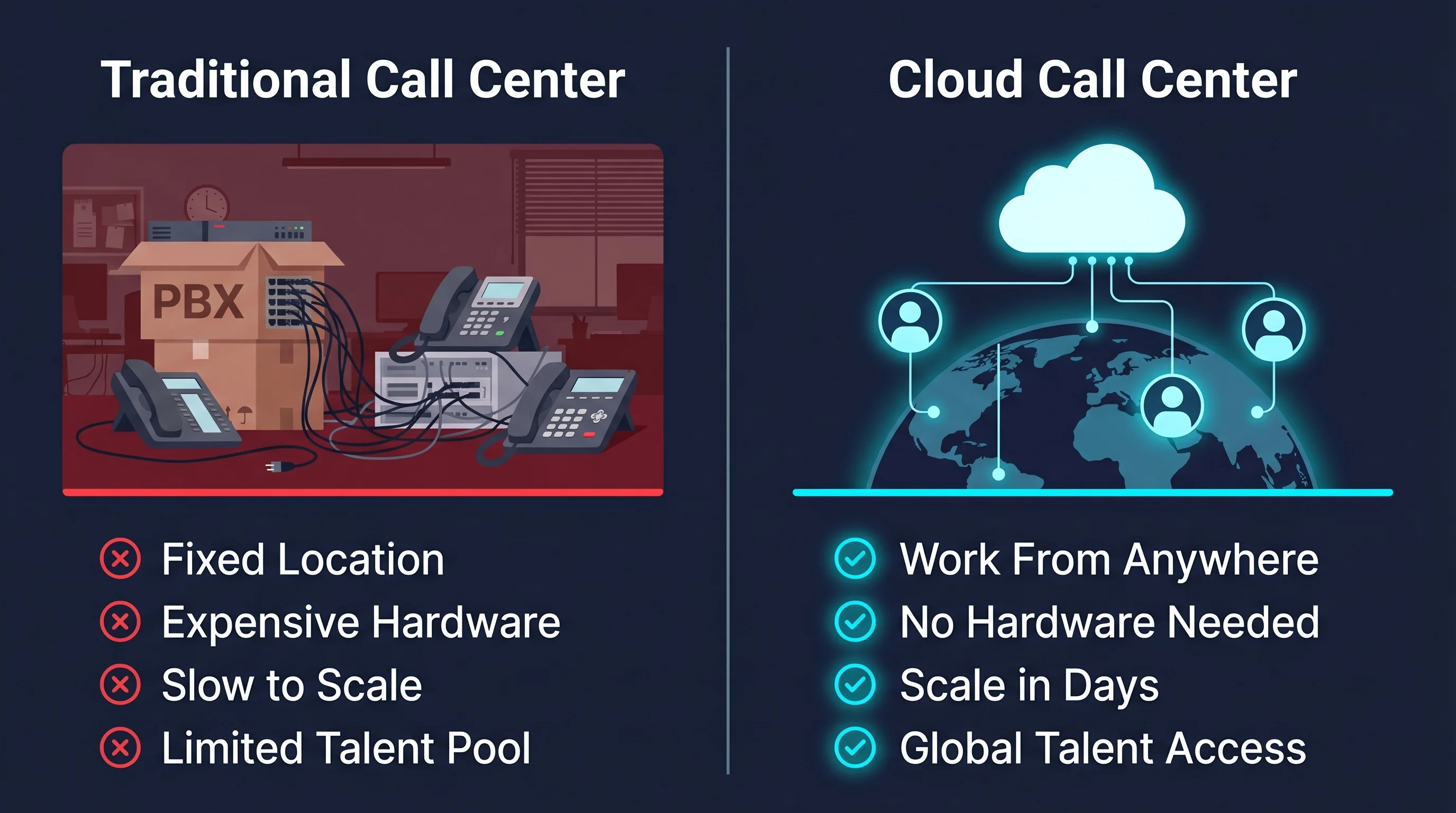
The difference is night and day. Cloud call centers aren't just cheaper—they're fundamentally better for modern business.
Key Components of a Cloud Call Center System
When you set up a cloud call center, you're not buying one monolithic system. Instead, you're combining several specialized components that work together seamlessly. Let's break down each one:
1. VoIP Infrastructure (The Foundation)
VoIP (Voice over Internet Protocol) is the backbone. Instead of calls traveling through analog phone lines, they travel as data packets over the internet.
Your VoIP provider delivers the connection to the public phone network, ensures call quality, and provides SIP trunking (the pipes that carry your calls).
A reliable VoIP provider for call centers must offer:
- 99.9%+ uptime guarantee
- Crystal-clear call quality
- Instant scaling capability
- Global reach
- Competitive pricing
2. Cloud PBX or Asterisk Hosting (The Brain)
Your PBX (Private Branch Exchange) is the switching system that routes calls. In the cloud version, you don't buy a physical box—you use hosted infrastructure.
Many cloud call center setup deployments use Asterisk PBX hosting—an open-source system that's incredibly powerful and flexible. Asterisk powers thousands of call centers because it's:
- Cost-effective
- Highly customizable
- Capable of handling thousands of concurrent calls
- Integrates with any dialer or CRM
3. Call Center Dialer (The Workhorse)
If you need outbound capability, a call center dialer is essential. Vicidial hosting is the industry-standard open-source dialer for cloud call centers.
Vicidial is powerful because it:
- Handles predictive, progressive, and preview dialing modes
- Records all calls automatically
- Provides real-time dashboards
- Offers agent performance metrics
- Integrates with CRMs
- Supports thousands of concurrent calls
- Is cost-effective for hosting
4. IVR System (The Receptionist)
IVR (Interactive Voice Response) automates call handling. Customers call, hear options ("Press 1 for sales, 2 for support"), and route automatically to the right department.
A good IVR system:
- Reduces call volume to agents
- Improves customer experience
- Collects important information upfront
- Operates 24/7 without employee cost
5. CRM Integration (The Intelligence)
Your cloud call center should integrate with your CRM (Salesforce, HubSpot, Pipedrive, etc.). When a customer calls, their full history appears on the agent's screen—context, previous interactions, open tickets.
This integration dramatically improves:
- First-call resolution rates
- Customer satisfaction scores
- Agent productivity
- Sales effectiveness
Why Businesses Need Cloud Call Centers (5 Undeniable Benefits)
1. Streamlined Logistics & Deployment Speed
The physical and operational burden of setting up new agents is virtually eliminated in a cloud environment. You move from a hardware-heavy process to a software-driven one.
Traditional Setup
Requires ordering physical desk phones, running Ethernet cabling through offices, and configuring hardware on-site for every single agent. Onboarding a new hire takes days of IT work.
Cloud Setup
Agents simply log in via a web browser or softphone app. New team members can be onboarded in minutes from anywhere in the world with zero hardware installation or cabling required.
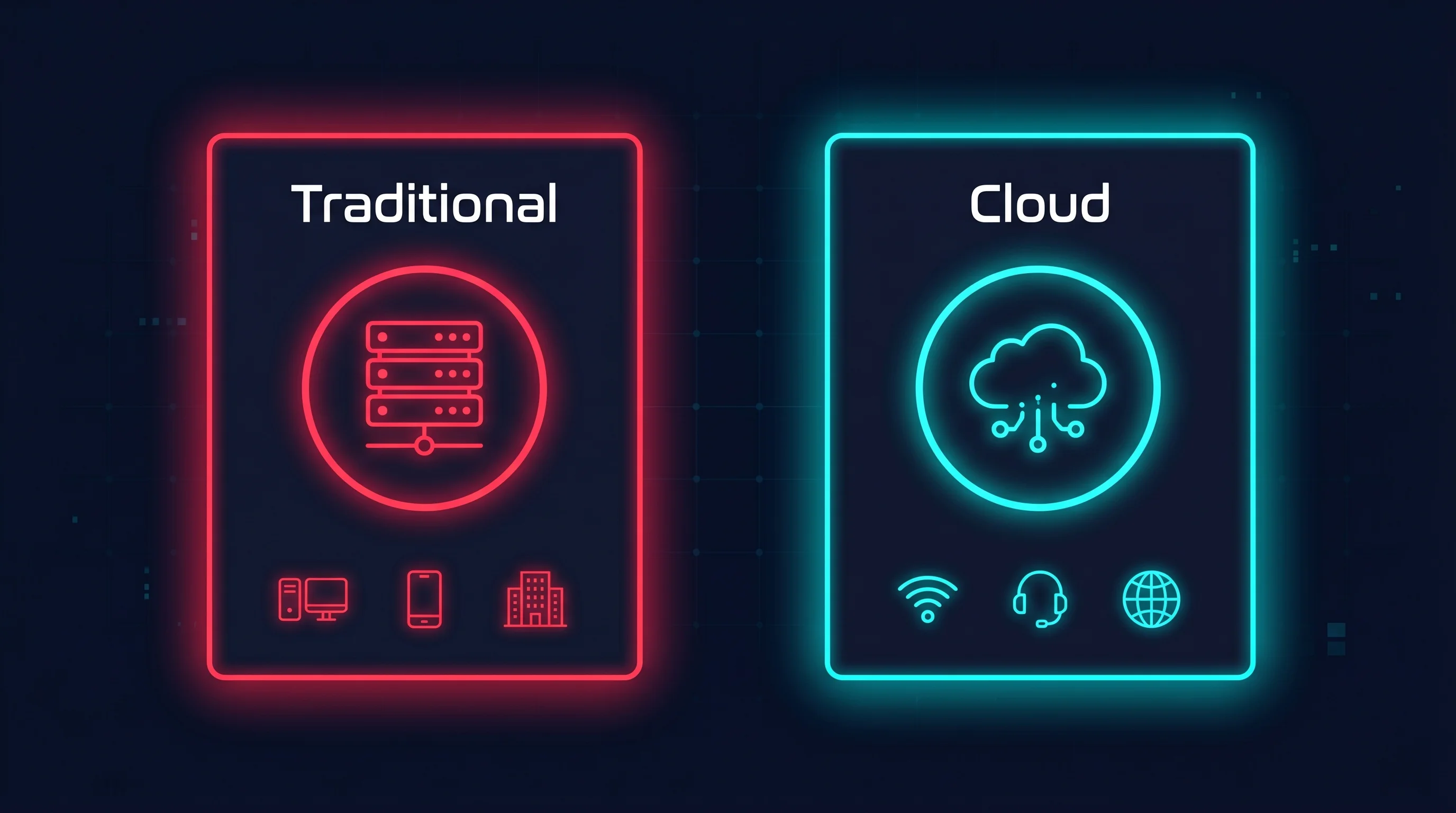
The savings are staggering. You invest less and operate for a fraction of the cost.
2. Unlimited Scalability
Need to add 100 agents next month for a seasonal campaign? With traditional systems, that's a nightmare. With cloud, you add agents in days.
Adding agents means:
- Create login credentials
- Point them to cloud dialer/PBX
- They work from home
- You're done
No hardware to purchase. No installation. No waiting. Just growth.
3. Remote Workforce Enablement
Post-pandemic, distributed teams are standard. Cloud call centers are designed for this.
Your agents can work from:
- Home offices
- Co-working spaces
- Coffee shops
- Multiple countries
- Any location with internet
This opens access to talent pools you previously couldn't reach. Hire the best agent in Montana instead of settling for the only local candidate.
4. Global Operations (Truly International)
With a traditional call center, international expansion means building new offices, hiring local teams, setting up international phone lines—expensive and slow.
With a cloud call center solution, you:
- Set up agents in different countries
- Buy local phone numbers instantly
- Route calls appropriately by region
- Operate globally from day one
It's not even close in terms of feasibility.
5. Superior Management and Analytics
Cloud call centers provide real-time visibility into everything:
- Live agent performance
- Call quality metrics
- Customer satisfaction scores
- Revenue per call
- Call duration trends
- Call recording library
You make decisions based on data, not guesswork. You identify problems in real-time and fix them immediately.
Step-by-Step Guide: How to Set Up a Cloud Call Center
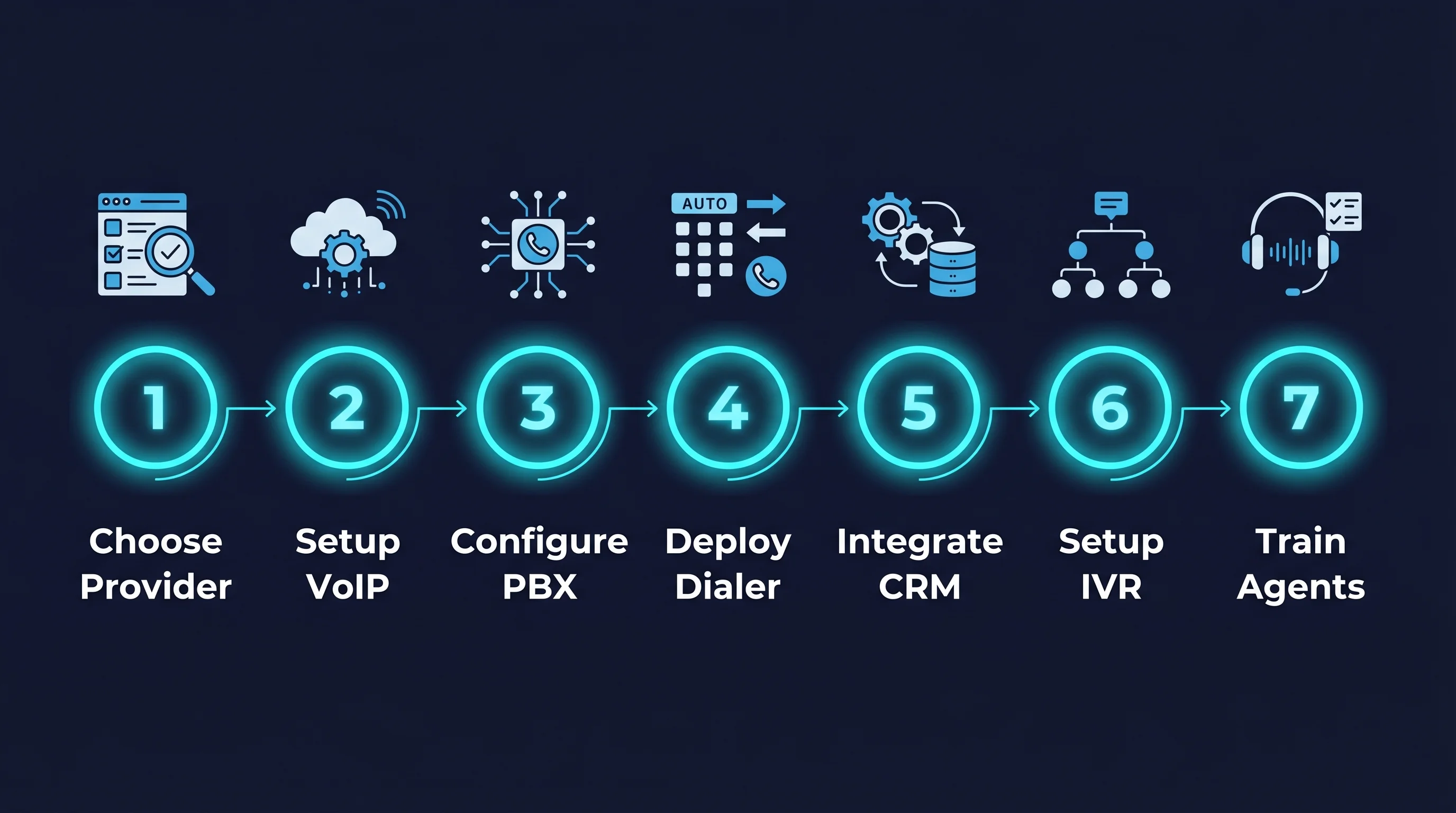
Ready to build your cloud call center? Here's the exact process:
Choose Your Cloud Call Center Provider
This is the most critical decision. Your provider delivers the foundation for everything. Look for a provider offering complete solutions, Vicidial hosting, Asterisk PBX hosting, 99.9%+ uptime, and expert support.
Set Up Your VoIP Infrastructure
Your provider configures SIP trunks, DID numbers, call routing rules, and redundancy. Typically takes 1-2 days.
Configure Your Asterisk or Cloud PBX
Set up extensions, call queues, routing rules, voicemail, hold music, and announcements. Most providers offer templates.
Deploy Your Dialer (If Needed)
If using outbound, Vicidial hosting handles predictive dialing, call lists, scripts, recording, and dashboards.
Integrate Your CRM
Connect your CRM so customer data pops on agent screens. Call recordings link to records, dispositions update automatically.
Set Up Your IVR System
Create call menus ("Press 1 for sales"), route by selection, collect info upfront, offer self-service options.
Recruit and Train Agents
Hire remote agents, provide headsets & training, launch with 5-10 agents, then scale rapidly.
Critical Features to Look for in a Provider
When evaluating providers for your cloud call center setup, prioritize these features:
- Complete Solution: One vendor for VoIP + PBX + dialer beats piecing together multiple systems.
- Vicidial Hosting: Open-source, infinitely customizable, proven at scale, supports predictive dialing.
- Asterisk PBX Flexibility: Customizable for your unique call center requirements.
- Call Recording & Compliance: Secure storage, searchable archives, GDPR/TCPA/HIPAA compliance.
- Real-Time Analytics: Agent productivity, call quality, satisfaction scores, revenue trends.
- 99.9%+ Uptime SLA: Automatic failover, redundancy, zero downtime tolerance.
- Transparent Pricing: No hidden fees, no long-term contracts, per-agent scaling.
Real-World Use Cases: Cloud Call Centers in Action
Customer Support: SaaS company deployed 10 agents across US/UK using Vicidial hosting. Achieved 95% CSAT while cutting support costs 50%.
Outbound Sales: B2B lead gen company deployed cloud infrastructure for $5,000 + $1,500/mo. Scaled to 150 agents in 6 months—impossible with traditional setup.
BPO Operations: Firm manages 20 clients using single cloud infrastructure with Asterisk PBX hosting and multiple Vicidial instances. Each client gets isolated infrastructure at fraction of cost.
Remote-First Teams: Healthcare center employs agents across 15 states. No physical office. 60% cost reduction, 30% higher agent satisfaction.
Where to Find the Best Cloud Call Center Solution Provider
The market offers many options. Generalist providers (Twilio, RingCentral) spread resources thin. Specialist providers focus specifically on call center infrastructure, investing heavily in Vicidial expertise, Asterisk optimization, call quality, and scale reliability.
A specialist call center solution provider typically outperforms generalists in reliability, customization, and cost.
Why NexGenVoice for Your Cloud Call Center Setup
When you're ready to set up a cloud call center, choosing the right provider makes all the difference. Here's why NexGenVoice stands out:
Complete, Integrated Solution
Enterprise-grade VoIP, managed Asterisk PBX, proven Vicidial hosting, CRM integration, recording/compliance, and real-time analytics. Everything integrates perfectly.
Proven Call Center Expertise
Deployed hundreds of cloud call centers across customer support, sales operations, outbound campaigns, BPOs, and contact centers. We know what works.
Asterisk & Vicidial Hosting Done Right
Fully redundant, automatically backed up, infinitely customizable, capable of 1,000+ concurrent calls, supported by experienced engineers. Deploy in days, scale in weeks.
Wholesale VoIP Pricing
As a wholesale VoIP provider, we pass savings to you: per-agent pricing, no setup fees, no contracts, transparent billing.
24/7 Expert Support & Global Infrastructure
Real humans, senior engineers, proactive monitoring. Data centers on 5 continents, local numbers in 150+ countries, same-day resolution SLA.
Key Takeaways
Conclusion: Your Cloud Call Center Awaits
Traditional call centers are becoming obsolete. The economics simply don't work anymore. The flexibility doesn't exist. The scalability isn't there.
Cloud call centers aren't the future—they're the present. And businesses that haven't moved are losing to competitors who have.
Whether you're starting your first inbound operation, scaling an existing call center, moving from traditional infrastructure, launching an outbound campaign, or building a global contact center—a cloud-based solution solves your problems.
The process is straightforward:
- Choose a provider specializing in call center solutions
- Set up VoIP infrastructure (provider handles most)
- Deploy Asterisk PBX hosting or Vicidial hosting
- Configure call routing, IVR, and CRM integration
- Hire and train agents
- Go live and scale
Today is the perfect day to start. NexGenVoice makes it effortless. Our complete infrastructure, proven expertise, and transparent pricing mean you can launch a professional cloud call center in days—not months—at a fraction of traditional costs.
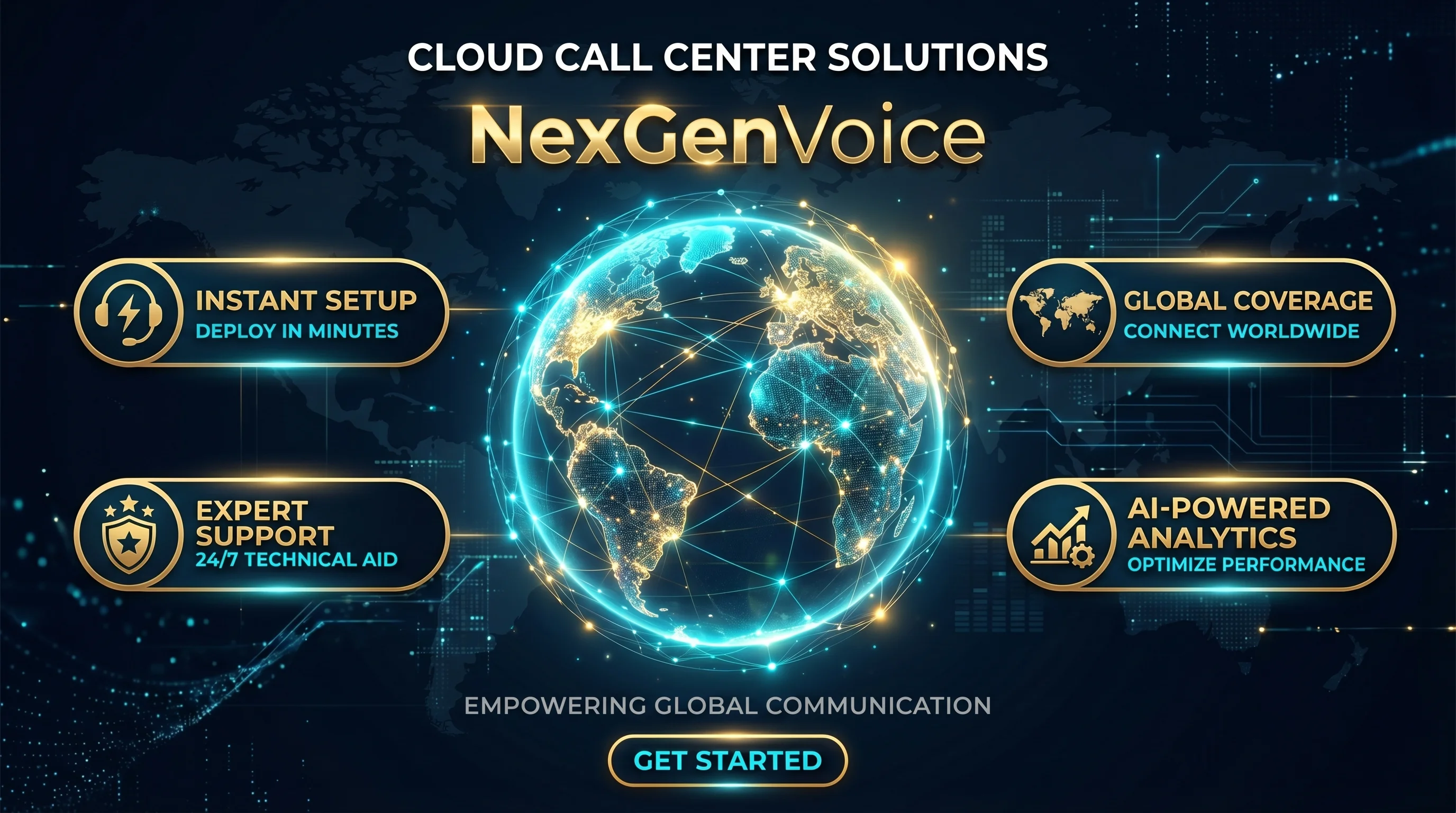
Ready to Launch Your Cloud Call Center?
Start today: NexGenVoice makes deployment effortless. Launch a professional cloud call center in days—not months—at a fraction of traditional costs. Save on your telecom expenses.
Get StartedFrequently Asked Questions
Basic cloud call centers can be deployed in 3-7 days. Complex configurations with custom integrations may take 2-4 weeks. This compares to 3-6 months for traditional on-premise setups.
Yes! Most providers offer migration support. You can port existing phone numbers, transfer call recordings, and migrate CRM data. NexGenVoice provides free migration support when switching from another provider, with zero downtime during the transition.
Agents need a computer, reliable internet (10+ Mbps), and a quality USB headset. No special phones or hardware required. Softphone applications run in browsers or as desktop apps. We recommend noise-canceling headsets for best call quality.
Yes! Top providers like NexGenVoice offer DID numbers in 150+ countries. You can buy local numbers instantly, route calls to agents anywhere, and present a local presence globally.
Enterprise-grade cloud call centers offer encryption, secure data centers, compliance with GDPR, HIPAA, TCPA, and PCI-DSS. Call recordings are stored securely with access controls and audit logs.
Vicidial is the industry-standard open-source dialer used by thousands of call centers worldwide. It's cost-effective, infinitely customizable, proven at scale, and supports predictive, progressive, and preview dialing modes.
.png)