Why Your Phone System Choice Matters
The central decision facing businesses today is whether to adopt Voice over Internet Protocol (VoIP) or stay with a traditional phone system. Both approaches serve the fundamental need to connect people but they differ substantially in cost, scalability, flexibility, and the features they provide.
Every business depends on communication systems to connect teams and customers. The two most common options today are VoIP and traditional phone systems. This guide compares both across cost, scalability, features, and reliability to help you understand which fits your business needs.

Understanding Traditional Phone Systems
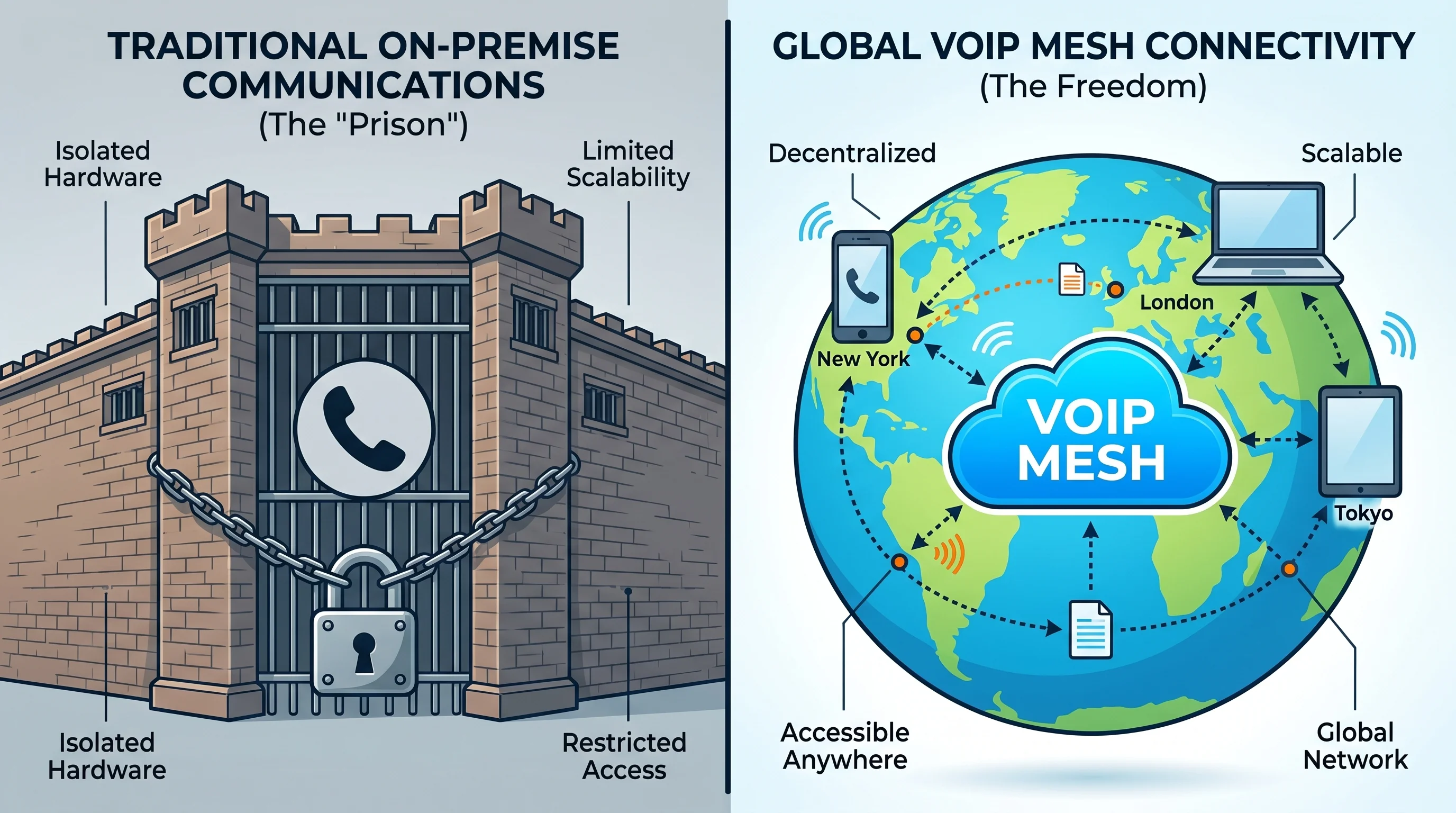
For many decades, traditional phone systems served as the bedrock of business communication. They rely on the Public Switched Telephone Network (PSTN) a circuit-switched infrastructure that transmits voice signals through physical copper wires. While reliable, traditional phone systems have limitations in cost, scalability, and remote access.
How Traditional Systems Work
A traditional business phone setup typically involves a Private Branch Exchange (PBX) unit installed on-site. This hardware routes calls between internal extensions and connects the business to the external telephone network. Every phone line requires its own dedicated physical connection wiring that runs through walls, ceilings, and telecommunications cabinets.
Advantages of Traditional Systems
Reliability remains the strongest case for conventional systems. Because they do not depend on internet connectivity, they can continue operating during internet outages. Call quality is generally consistent and predictable, free from the bandwidth-related degradation that can sometimes affect internet-based calls on poorly configured networks.
For businesses in areas with unstable or slow internet infrastructure, a traditional PSTN line can be the more reliable option at least until connectivity improves.
Key Limitations
-
High Installation & Maintenance Costs Physical PBX hardware, copper wiring, and licensed desk phones require significant upfront capital and ongoing maintenance contracts.
-
Limited Scalability Expanding requires additional physical lines, hardware, and often a full site visit from a telecoms engineer a process that takes days or weeks, not minutes.
-
No Remote Work Support Calls are tied to a physical desk and location. Workers away from the office are effectively cut off from the main system without complex and expensive workarounds.
-
Outdated Feature Set Video conferencing, CRM integration, voicemail-to-email, and real-time analytics are either unavailable or require expensive add-ons and third-party hardware.
Worth noting: Traditional PSTN infrastructure is actively being decommissioned in many countries. The UK's PSTN switch-off is scheduled for late 2025, and similar timelines are underway across Europe and North America. For many businesses, switching to VoIP is not optional it is a matter of when, not if.
What is VoIP?
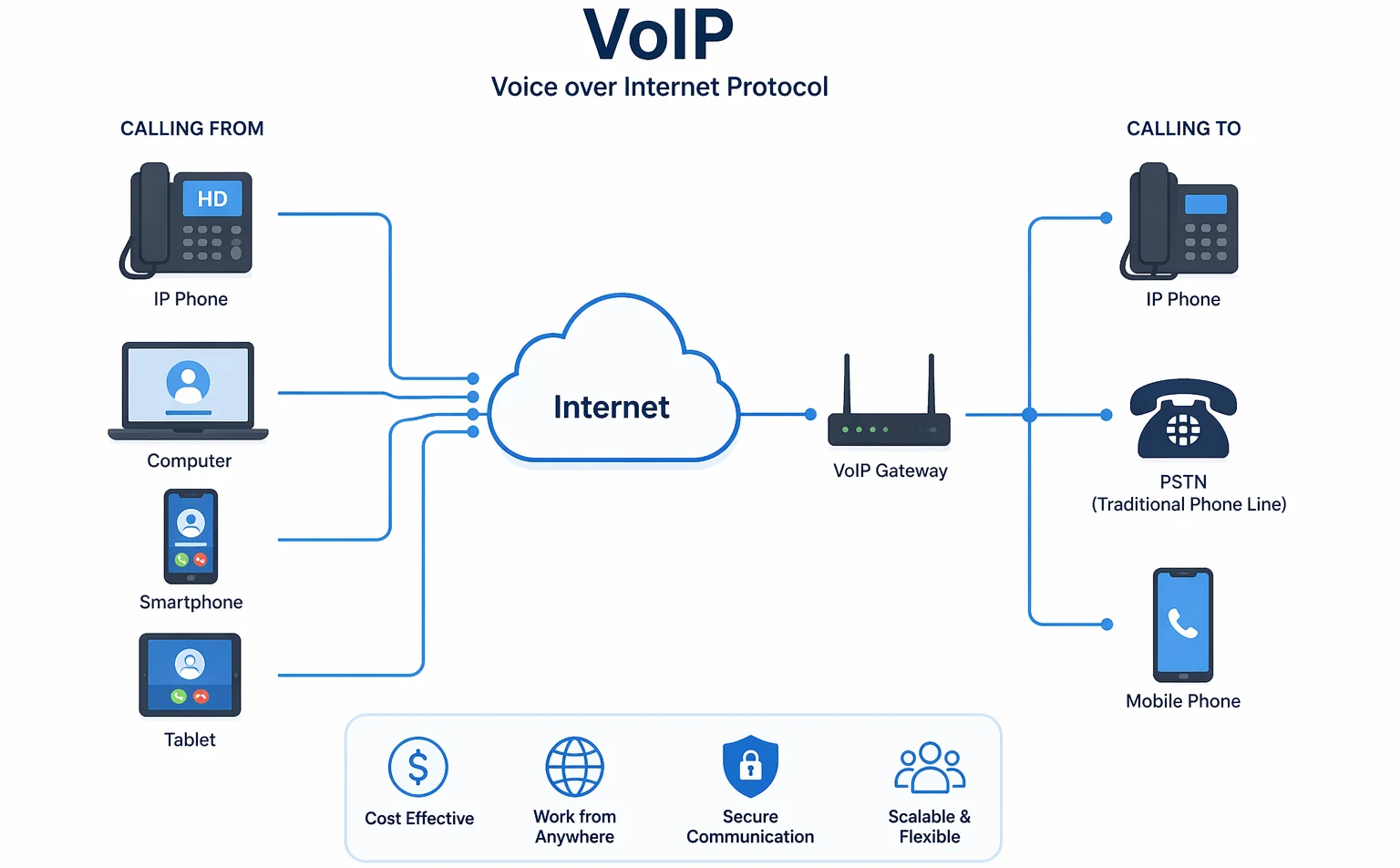
Voice over Internet Protocol (VoIP) is a communication technology that converts voice into digital data packets and transmits them over the internet. Instead of routing calls through copper telephone lines and a physical PBX, VoIP uses your existing internet connection to handle all voice traffic.
How VoIP Works
When you speak into a VoIP-enabled device, your voice is digitised, compressed, and broken into small data packets. Those packets travel across the internet to their destination, where they are reassembled and converted back into audio almost instantaneously. The same connection that carries your email and web traffic also carries your calls.
Users can access the VoIP system from a traditional desk phone (connected via an adapter), a softphone application on a laptop, or a mobile app. The hardware is largely optional, and the infrastructure lives in the cloud rather than in a server room.
Key Features VoIP Brings
-
HD Voice & Video Calling Crystal-clear voice quality and integrated video conferencing without needing separate platforms or subscriptions.
-
Voicemail-to-Email Missed voicemails are automatically transcribed and delivered to your inbox, keeping your team responsive even when unavailable.
-
Auto-Attendant & IVR Automated greetings and intelligent call routing direct customers to the right department without requiring a live receptionist.
-
CRM & Tool Integrations Native connections to Salesforce, HubSpot, Zoho, and other platforms deliver click-to-call, automatic call logging, and screen pop functionality.
-
Real-Time Analytics Live dashboards tracking call volumes, agent performance, queue wait times, and call quality data traditional systems simply cannot provide.
-
Call Forwarding & Number Portability Route calls to any device, any location, with full control. Keep your existing business number when switching providers.
Before choosing a VoIP provider, compare network redundancy, call quality, global coverage, pricing transparency, and CRM integration support.
How to Transition to VoIP in 3 Simple Steps
Migrating from a legacy system might sound daunting, but the process is highly streamlined. Follow these steps to ensure a smooth transition:
Run a simple speed test to ensure you have at least 100 kbps of dedicated upload/download speed per concurrent call. Check our Network Assessment Guide for a detailed checklist.
Decide whether your team will use softphones (desktop/mobile apps), physical IP phones, or a mix of both. Softphones require zero hardware setup.
You can retain all your existing business numbers. Submit a Letter of Authorization (LOA) to your new provider, and they will handle the background routing transfer seamlessly.
Need a deeper migration walkthrough?
VoIP vs Traditional Phone Systems: Side-by-Side Comparison
Let's break down the key differences across every dimension that matters for a business communication decision.
| Factor | VoIP | Traditional (PSTN/PBX) | Winner |
|---|---|---|---|
| Upfront Cost | Low — minimal hardware, subscription-based pricing | High — PBX hardware, wiring, and licensed phones | VoIP |
| Monthly Cost | Predictable per-user pricing; lower international rates | Per-line fees, high international call charges | VoIP |
| Scalability | Add lines and users in minutes, no hardware needed | Requires physical installation; days or weeks to scale | VoIP |
| Setup Time | Deploy in hours — cloud-based, no physical wiring | Complex installation; wiring, hardware, configuration | VoIP |
| Reliability | High with redundant infrastructure; internet-dependent | Works without internet; steady in poor connectivity areas | Traditional |
| Remote Work | Full remote and mobile access from any device | Desk-bound; no remote access without workarounds | VoIP |
| Features | Video, IVR, analytics, CRM integrations, call recording | Basic calling; advanced features require costly add-ons | VoIP |
| Maintenance | Managed by provider; no on-site hardware to maintain | Requires on-site IT or specialist telecoms engineers | VoIP |
| Future-Readiness | Cloud-native; continuous feature updates included | PSTN being decommissioned globally by 2025–2027 | VoIP |
Summary: VoIP performs better in most business use cases, especially for scalability, cost efficiency, and remote work support. Traditional systems may still be suitable in low-internet environments.
Based on this comparison:VoIP tends to be the better fit for businesses prioritizing scalability, remote work, and lower operating costs. Traditional systems may still work well for businesses operating in areas with unreliable internet infrastructure.
How a Logistics Company Reduced Communication Costs by 60%
A logistics company operating across the US, UK, and Germany was managing 150+ employees across multiple offices while relying on outdated PBX systems.
After switching to VoIP:
💰 Want to see similar savings for your business?
Businesses expanding internationally should evaluate local number availability, compliance requirements, and regional call quality before deploying virtual numbers.
Why VoIP is Gaining Rapid Popularity
VoIP is not simply a cheaper phone system it represents a fundamental shift in how business communication is delivered, managed, and scaled. Here is why adoption is accelerating across organisations of every size.
Dramatically Lower Costs
VoIP eliminates the need for dedicated phone lines and removes the infrastructure overhead that makes traditional systems so expensive to operate. For businesses with international calling needs, the savings are especially significant Businesses often reduce international communication costs after switching to VoIP due to lower per-minute rates and fewer infrastructure expenses. compared to PSTN rates. The subscription model also means no unexpected maintenance invoices or hardware replacement bills.
Remote Accessibility Without Compromise
With VoIP, your business phone number follows your team not your office. Employees working from home, travelling, or operating from a different country connect to the same system with the same extension, the same voicemail, and the same features they would have at a physical desk.
Scaling on Demand
Seasonal call centres, fast-growing startups, and enterprises opening new offices all benefit from VoIP's ability to scale in real time. Adding fifty agents for a campaign launch or spinning up lines for a new department takes minutes through a web dashboard with no site visits, no hardware orders, and no waiting.
A Feature Set Built for Modern Business
Beyond voice calls, VoIP platforms deliver video conferencing, team messaging, call recording, real-time analytics, and deep integrations with the tools your team already uses. These capabilities which would require multiple separate contracts with a traditional system are typically included in a single VoIP subscription.
Before selecting any provider, compare uptime guarantees, deployment timelines, integrations, and customer support quality.
Potential Drawbacks of VoIP
A balanced comparison requires acknowledging where VoIP has limitations. These are real considerations though for most businesses, they are manageable or temporary.
-
Internet Dependency VoIP requires a stable internet connection. If your connection goes down, so do your calls unless failover routing to mobile is configured.
-
Bandwidth Requirements Each concurrent call uses approximately 85–100 kbps of bandwidth. High call volumes need adequate upload/download capacity and QoS configuration.
-
Network Security VoIP calls travel over the internet and require proper encryption (SRTP/TLS), fraud monitoring, and network security measures to protect against interception.
-
Emergency Call Limitations VoIP emergency calling (911/999) works differently from PSTN. Some providers require address registration for accurate emergency dispatch routing.
In practice: These limitations depend on internet quality and network setup. Most modern providers include solutions such as redundancy and mobile failover.
Common VoIP Issues & How to Fix Them
When transitioning, you might encounter minor network-related hiccups. Here are the most common issues and educational resources to solve them:
- Jitter and Choppy Audio: Usually caused by network congestion. Solution: Enable Quality of Service (QoS) on your router to prioritize VoIP traffic over standard web browsing.
- One-Way Audio: Often a firewall or NAT (Network Address Translation) issue. Solution: Ensure SIP ALG is disabled on your router, as it frequently interferes with SIP packets.
- Dropped Calls: Can result from strict UDP timeouts. Solution: Increase the UDP timeout setting on your firewall, or switch to TCP transport in your softphone settings.
For more deep-dive technical solutions, visit our SIP Troubleshooting Knowledge Base.
If you're experiencing recurring SIP issues, review provider troubleshooting documentation, network redundancy options, and support response times before switching platforms.
Which System is Right for Your Business?
The right choice depends on your specific circumstances, infrastructure, and growth trajectory. Here is a clear framework to guide your decision.
- You want to reduce communication costs significantly
- Your team works remotely or across multiple locations
- You need flexibility to scale lines up or down quickly
- You require advanced features like CRM integration or analytics
- You are opening new offices or entering new markets
- You want to future-proof your communication stack
- You operate in an area with unreliable internet connectivity
- Your existing hardware investment is recent and substantial
- You only need basic outbound and inbound calling
- Regulatory requirements in your industry limit cloud solutions
For the vast majority of businesses in 2026, VoIP is the clear and sensible choice. The cost savings alone typically justify the switch within months, and the operational advantages compound over time as teams grow and communication needs evolve.
Need help choosing the right system?
Frequently Asked Questions
Everything you need to know before making the switch.
Yes. Most businesses reduce costs by removing hardware maintenance and lowering international call expenses. VoIP typically costs 40–70% less per line compared to traditional PSTN lines.
Yes. Most VoIP providers support number porting, allowing you to retain your existing business phone numbers during migration without any service interruption.
Small businesses can migrate in 24–48 hours. Larger enterprises with complex setups may take a few days to a week, depending on the number of lines, locations, and integrations required.
Most providers offer automatic failover routing to mobile devices or backup lines during internet outages, ensuring your calls are never missed even if your primary connection goes down.
Modern providers use TLS and SRTP encryption, fraud monitoring tools, and enterprise-grade firewalls. VoIP security is now on par with — or exceeds — traditional telephony when configured properly.
Conclusion
The comparison between VoIP and traditional phone systems has a clear outcome for most modern businesses. Conventional systems deliver reliability but at a high cost, with severe flexibility limitations and a feature set that does not match the demands of today's workforce.
VoIP offers a fundamentally better model: lower operating costs, instant scalability, full remote accessibility, and a rich feature set that improves productivity at every level. The transition from traditional telephony to internet-based communication is not a trend it is the direction the entire industry has been moving for a decade, and the pace is only accelerating.
Businesses that make this switch position themselves to compete more effectively, serve customers more responsively, and adapt to changing conditions far faster than those still tied to legacy infrastructure.
For most modern businesses, VoIP offers better scalability, lower operational costs, and greater flexibility than traditional systems.
Compare providers carefully and prioritize reliability, support quality, and scalability before migrating.
Compare Plans