What Is SIP Trunking?
Business communication is evolving rapidly. Traditional phone systems that once served as the backbone of office communication are becoming increasingly expensive, difficult to scale, and inefficient for modern work environments. Rising telecom costs, remote work adoption, and the need for flexible infrastructure are pushing organizations to explore smarter alternatives.
One technology leading this transformation is SIP Trunking (Session Initiation Protocol Trunking). From startups to enterprise call centers, businesses across industries are replacing legacy phone lines with SIP-based communication systems to reduce costs and improve operational efficiency. Organizations looking to modernize their phone infrastructure often start by evaluating VoIP solutions that combine SIP connectivity with cloud-based management.
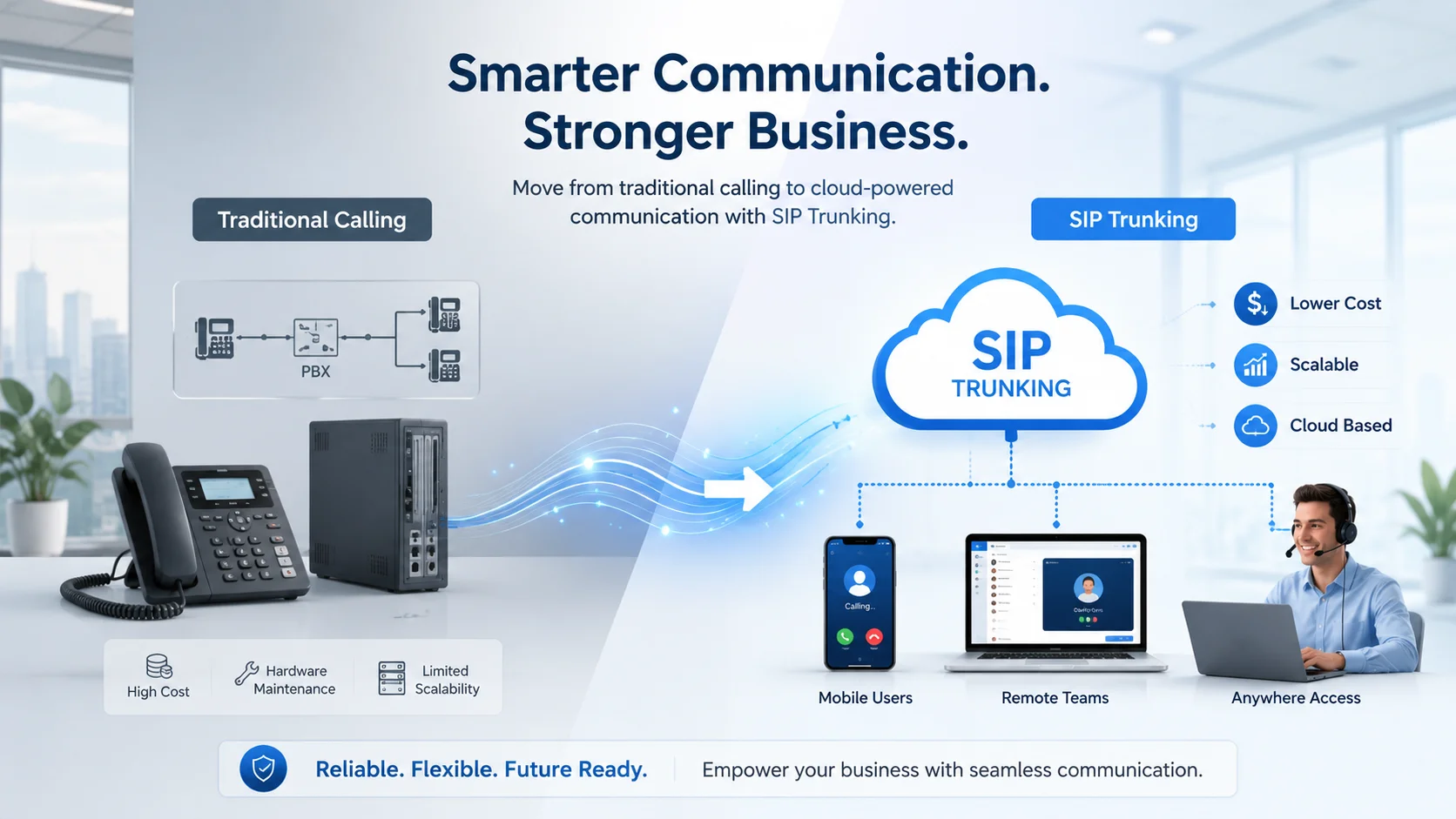
SIP trunking is a technology that allows businesses to make and receive voice calls over the internet instead of using traditional telephone lines. It connects an organization's PBX system to the public telephone network using a secure internet connection.
-
Virtual Phone ChannelsReplace multiple physical phone lines with flexible internet-based channels that scale instantly.
-
PBX IntegrationConnect your existing IP PBX or hosted cloud PBX directly to the public telephone network.
-
Inbound & Outbound CallsHandle all call types local, national, and international through a single managed connection.
-
No Physical Lines RequiredEliminate copper telephone infrastructure entirely and manage everything through software.
In simple terms, SIP trunking replaces expensive legacy infrastructure with a more flexible and cost-effective cloud communication model and it works alongside the PBX hardware or software your team already uses.
Businesses evaluating SIP trunking should assess their current line costs and call volumes before investing in additional traditional phone infrastructure.
Why Traditional Phone Systems Are Becoming Expensive
Legacy telephony systems were designed for a different era one where all staff were in the same office, call volumes were predictable, and technology changed slowly. The infrastructure model that worked in 2005 creates real friction and cost in 2026.
The core problem: Traditional telecom providers charge separately for physical lines, long-distance calls, international minutes, hardware upgrades, and maintenance. As businesses grow, these costs compound making legacy systems increasingly difficult to justify.
Common recurring expenses with traditional phone systems include installation of physical lines, PBX hardware maintenance, high international calling charges, costly expansion projects when adding staff, and dedicated IT support for telephony management. SIP trunking consolidates all of these into a single internet-based model, eliminating most of the overhead.
10 Reasons Businesses Are Switching to SIP Trunking
Whether you are running a growing startup, a multi-location business, or a high-volume call center, these ten advantages explain why SIP adoption continues to accelerate across every industry.
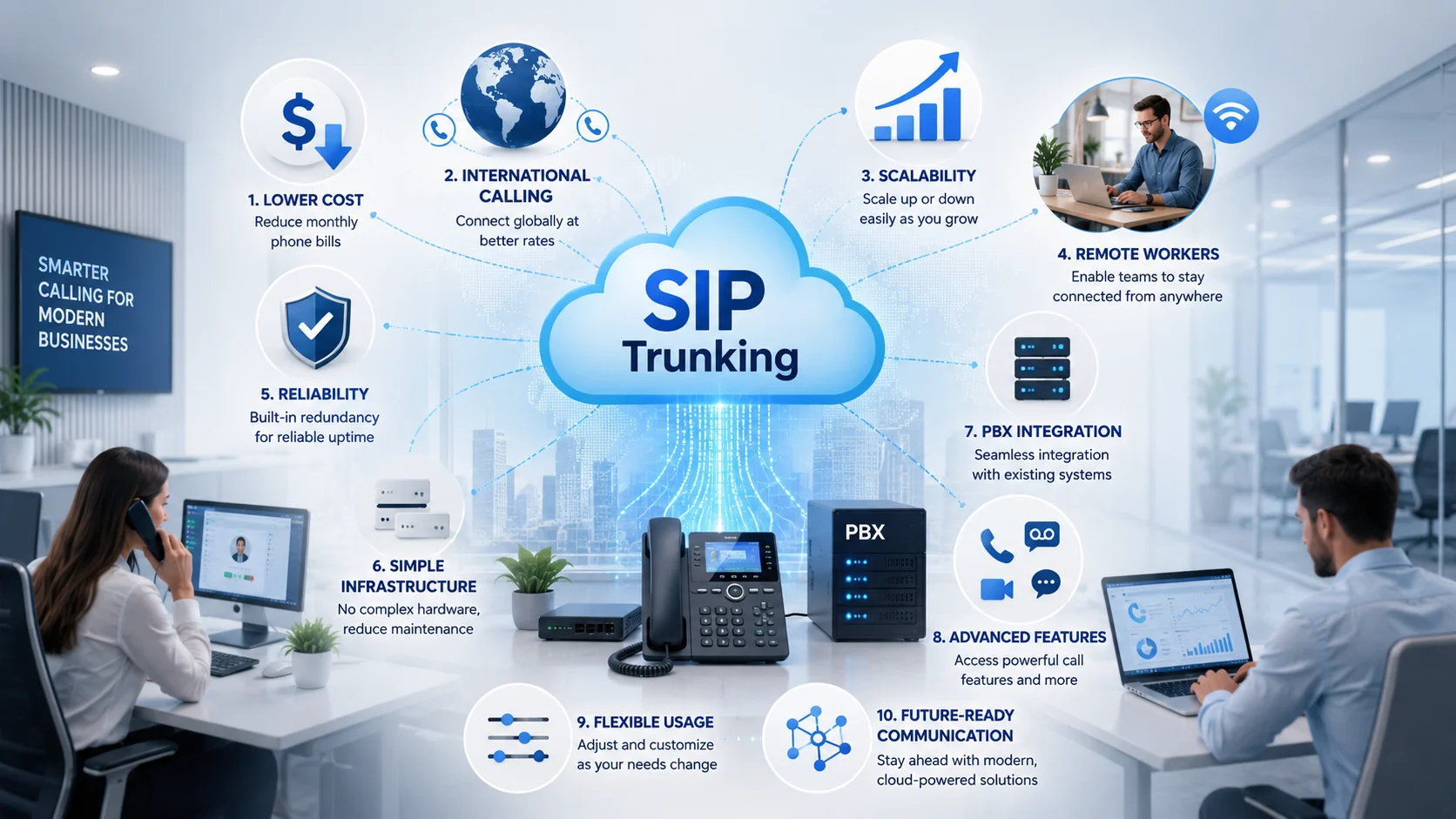
Scalable SIP trunking lets you add capacity when you need it and reduce it when you don't without the cost of permanent infrastructure upgrades.
SIP Trunking vs Traditional Phone Lines
This side-by-side comparison captures why so many businesses are making the switch. For most organizations, the gap between legacy telephony and SIP trunking has only widened as remote work and cloud infrastructure have become standard.
| Feature | Traditional Phone System | SIP Trunking |
|---|---|---|
| Setup Cost | ✕ High | ✓ Low |
| Scalability | ✕ Limited | ✓ Instant |
| International Calls | ✕ Expensive | ✓ Lower Cost |
| Remote Work Support | ✕ Limited | ✓ Excellent |
| Hardware Dependency | ✕ High | ✓ Minimal |
| Disaster Recovery | ✕ Basic | ✓ Advanced |
| Maintenance | ✕ Complex | ✓ Simplified |
| Capacity Flexibility | ✕ Fixed | ✓ On-Demand |
Is SIP Trunking Right for Your Business?
SIP trunking delivers value across a wide range of business types and sizes. Even small and medium-sized businesses benefit from the flexibility and scalability that SIP technology provides you do not need to be an enterprise to see meaningful cost reduction.
SIP trunking is particularly valuable for organizations that match one or more of these profiles:
-
5–10+ EmployeesTeams of any size benefit from consolidating phone costs and eliminating per-line fees.
-
Customer Support or Sales TeamsHigh call volumes amplify the cost savings and scalability benefits of SIP.
-
Frequent International CallsBPO companies and global enterprises save significantly on international calling rates.
-
Existing PBX or VoIP SystemsSIP trunking works alongside Asterisk, FreePBX, VICIdial, and most hosted PBX platforms.
-
Remote or Hybrid WorkforcesDistributed teams need communication infrastructure that works from anywhere.
-
Businesses Planning to ScaleSIP capacity grows with you no infrastructure procurement delays when you add headcount.
Companies planning future communication upgrades should consider SIP trunking as a long-term investment rather than a short-term cost-saving measure the infrastructure scales with the business.
How NexGenVoice Helps Businesses Transition to SIP Trunking
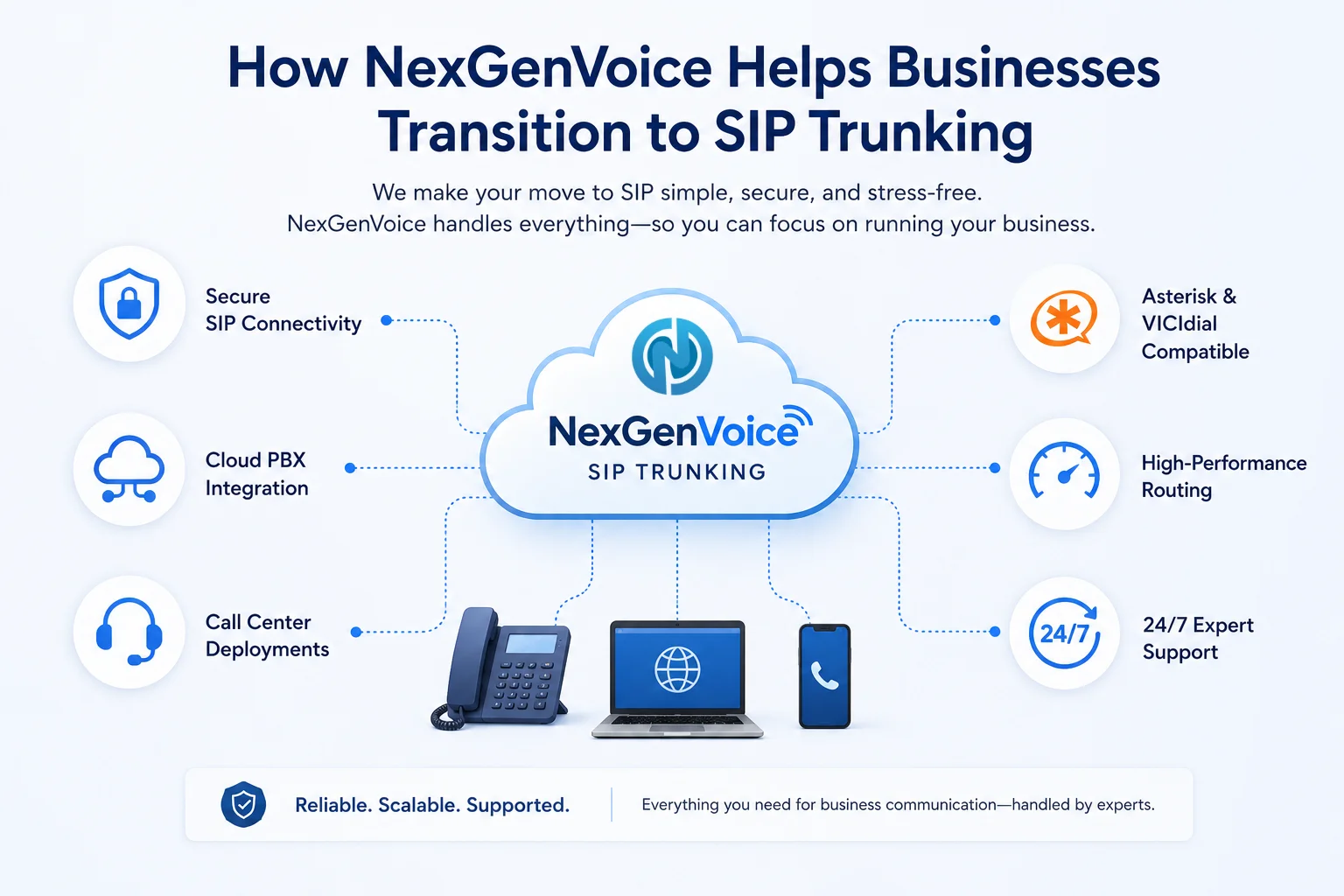
Moving from traditional telephony to SIP does not have to be complicated. NexGenVoice provides managed SIP trunking solutions designed for businesses that want enterprise-grade communication without enterprise-level complexity.
We handle deployment, configuration, and ongoing management so your team can focus entirely on running operations rather than maintaining telephony infrastructure. Our SIP infrastructure solutions support organizations ranging from growing startups to large-scale call center deployments.
Frequently Asked Questions
Common questions businesses ask before switching from traditional phone systems to SIP trunking.
SIP trunking connects your business phone system (PBX) to the public telephone network over the internet instead of through physical copper lines. SIP stands for Session Initiation Protocol the standard used to initiate, manage, and terminate voice calls over IP networks. Your PBX handles internal call management, while the SIP trunk provides the connection to external numbers for inbound and outbound calls.
Savings vary by organization size and call volume, but most businesses eliminate the cost of multiple physical phone lines, reduce international and long-distance rates significantly, and lower IT maintenance overhead by removing legacy hardware. High-volume operations such as call centers and BPO companies typically see the largest percentage savings.
Yes. Remote work support is one of SIP trunking's core advantages. Employees can connect from home offices, branch locations, international offices, or mobile devices. As long as a stable internet connection is available, the communication experience is identical to working from the main office same extensions, same features, same call quality.
In most cases, yes. SIP trunking is compatible with the majority of modern IP PBX platforms, including Asterisk, FreePBX, 3CX, and hosted cloud PBX environments. VICIdial-based call center deployments also integrate seamlessly with SIP trunking. Compatibility depends on your specific system and configuration, but the transition is generally straightforward with a managed provider handling setup.
Yes. Even small teams with five to ten employees benefit from SIP trunking. The ability to reduce monthly phone line costs, support remote staff, and access advanced features like call recording and voicemail-to-email without investing in dedicated hardware makes it a practical choice regardless of company size. SIP also scales easily as the business grows without requiring infrastructure overhauls.
Conclusion
As businesses continue to modernize their operations, communication infrastructure plays a crucial role in controlling costs and improving operational efficiency. SIP trunking addresses the core limitations of traditional phone systems by offering lower costs, easier scalability, stronger remote work support, and advanced communication features without the overhead of legacy hardware and maintenance.
Whether you operate a growing startup, a multi-location business, or a high-volume call center, SIP trunking provides a flexible foundation for future growth while significantly reducing ongoing telecom expenses.
Organizations that make the transition today are not only reducing costs they are building communication systems designed for tomorrow's business environment. The investment pays off immediately in reduced monthly bills, and compounds over time as the business scales without the infrastructure constraints of traditional telephony.
Get managed SIP trunking with secure connectivity, cloud PBX integration, Asterisk and VICIdial compatibility, and 24/7 expert support.
Custom deployment and migration support included.