What Is Wholesale VoIP?
In today's digital communication landscape, Voice over Internet Protocol (VoIP) has transformed the way businesses and individuals communicate across the globe. While many people are familiar with retail VoIP services, fewer understand the powerful business opportunities available through the wholesale VoIP model.
Wholesale VoIP is a telecommunications business model in which providers purchase voice traffic capacity or call minutes in bulk from large carriers and then resell those services to other businesses, VoIP providers, call centers, resellers, or enterprises. Rather than selling directly to end-users, wholesale VoIP providers operate behind the scenes — supplying the infrastructure and call routing services that power communication systems around the world.
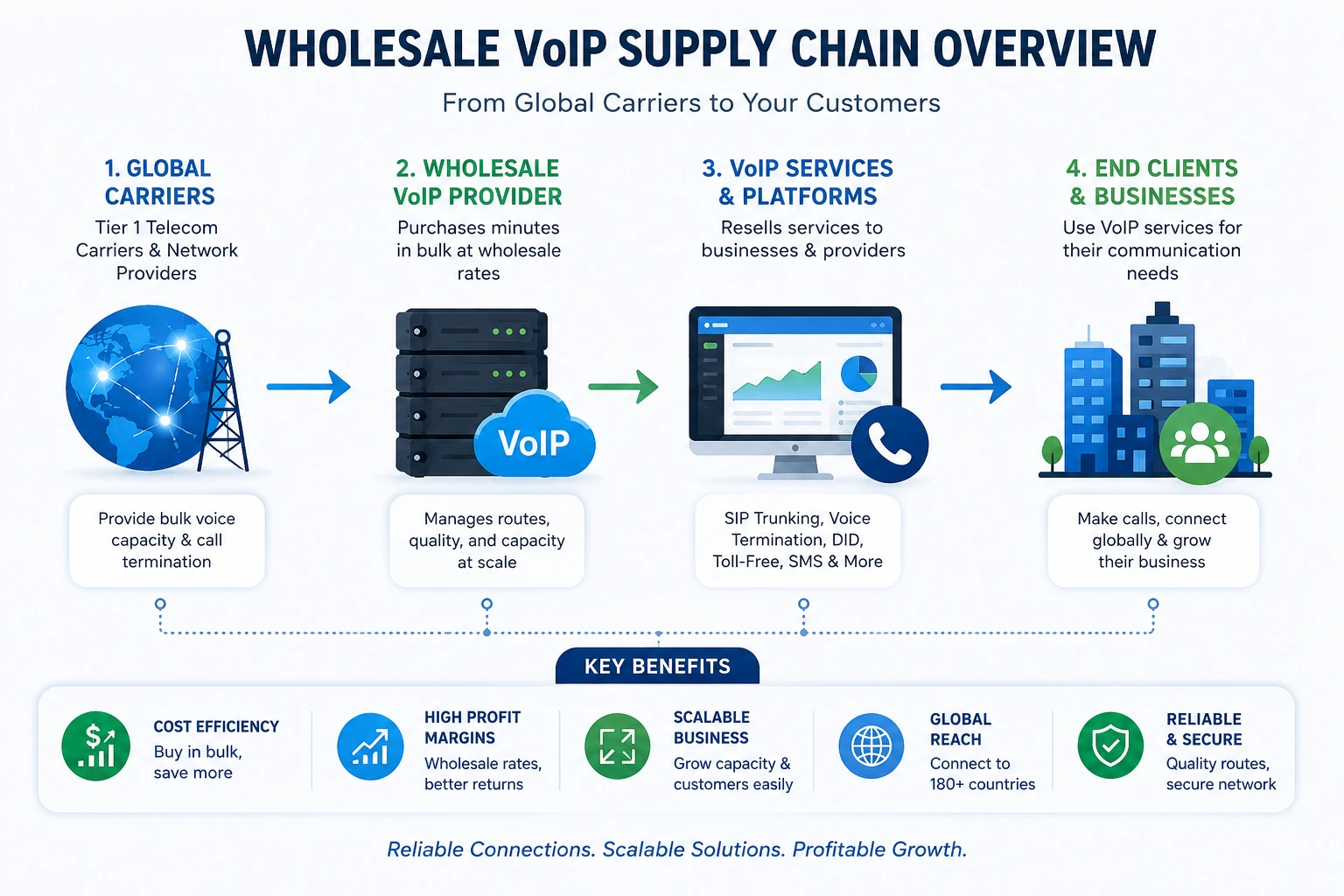
Think of it as a supply chain model: Large international carriers provide access to global telephone networks → wholesale VoIP providers purchase these services at discounted rates → they resell them to businesses requiring reliable voice communication solutions. This structure enables providers to leverage economies of scale while generating revenue through strategic pricing and efficient traffic management.
-
International Call RoutesAccess to global PSTN and VoIP termination across every major destination worldwide.
-
Domestic Voice TrafficHigh-volume inbound and outbound domestic call routing at bulk wholesale rates.
-
Mobile Network TerminationDirect mobile termination routes to carriers across North America, Europe, and Asia.
-
DID NumbersDirect Inward Dialing numbers for local presence across hundreds of countries and cities.
-
Toll-Free ServicesWholesale toll-free origination and termination for inbound contact center operations.
-
SMS SolutionsBulk SMS termination routes alongside voice, enabling unified messaging services.
How the Wholesale VoIP Business Model Works
The wholesale VoIP ecosystem involves several key participants working together to deliver voice communication services. Understanding each step helps entrepreneurs recognize where value is created and how revenue is generated at scale.
1. Purchasing Minutes in Bulk
The foundation of the wholesale VoIP model begins with purchasing voice termination services or call minutes from major telecom carriers. Because these minutes are purchased in large volumes, providers receive significantly lower rates compared to retail pricing. These wholesale agreements cover international routes, domestic traffic, mobile termination, toll-free services, and DID numbers.
2. Building Routing Infrastructure
After acquiring call capacity, providers establish VoIP infrastructure capable of routing calls efficiently across multiple networks. This infrastructure typically includes SIP servers, Session Border Controllers (SBCs), routing platforms, billing systems, monitoring tools, and quality management systems. Advanced routing technologies help ensure calls are delivered through the most cost-effective and reliable paths available.
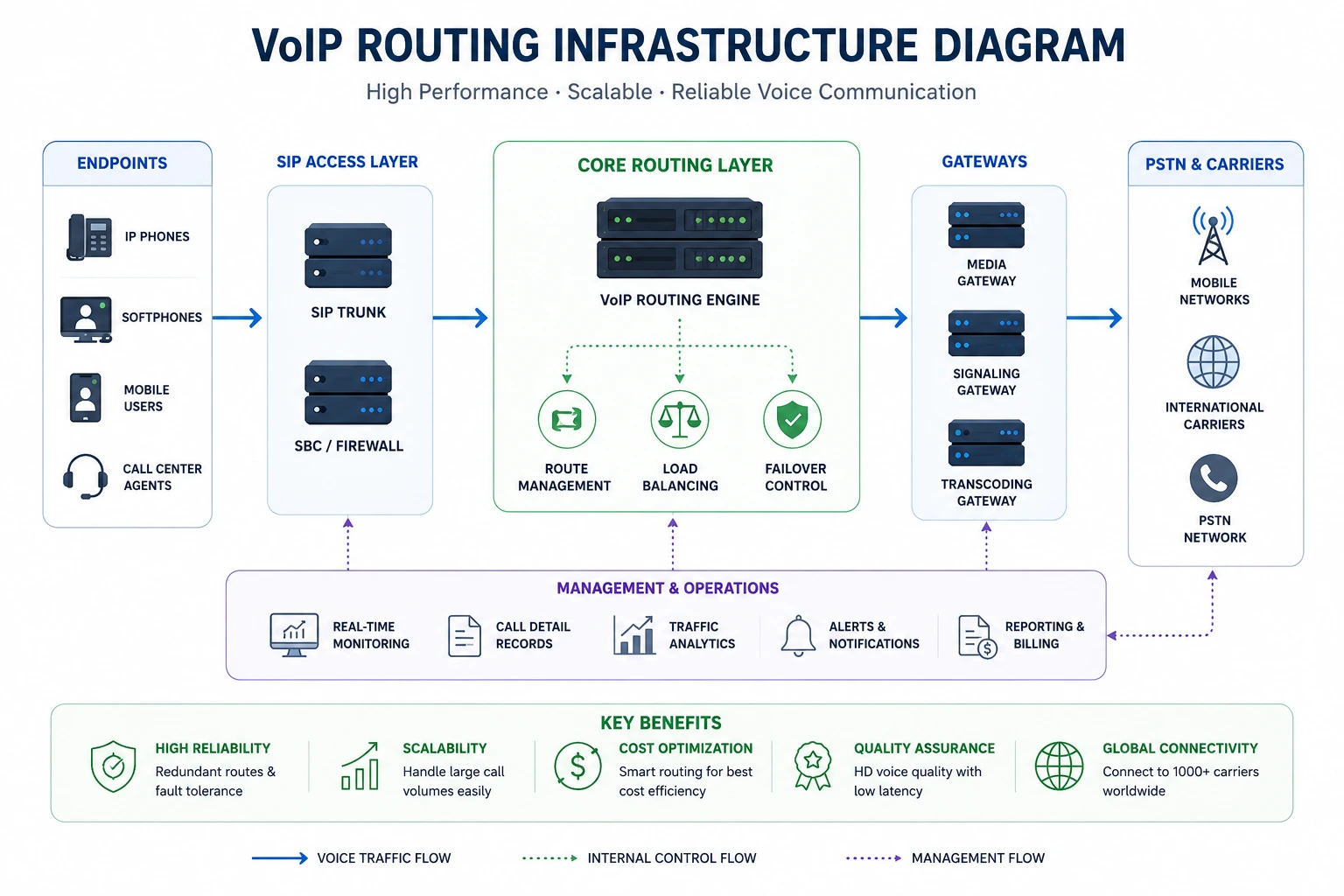
3. Reselling Services to Clients
Once the infrastructure is operational, providers begin reselling services to VoIP service providers, contact centers, business phone system providers, telecom resellers, international calling companies, and enterprise organizations. Customers gain access to voice services without having to negotiate directly with major carriers or invest heavily in telecom infrastructure.
4. Generating Revenue
Revenue is generated through the difference between the wholesale purchase cost and the resale price charged to clients. While individual margins may appear small, high call volumes can produce substantial profits over time.
At 10 million minutes per month, this $0.005/min margin produces $50,000 in monthly gross revenue — before infrastructure costs. Volume is the engine that drives wholesale VoIP profitability.
Ready to enter the wholesale VoIP market?
Key Components of a Wholesale VoIP Business
A successful wholesale VoIP operation relies on several core components working in concert. Weakness in any one area creates cascading problems across the entire operation.
Benefits of the Wholesale VoIP Business Model
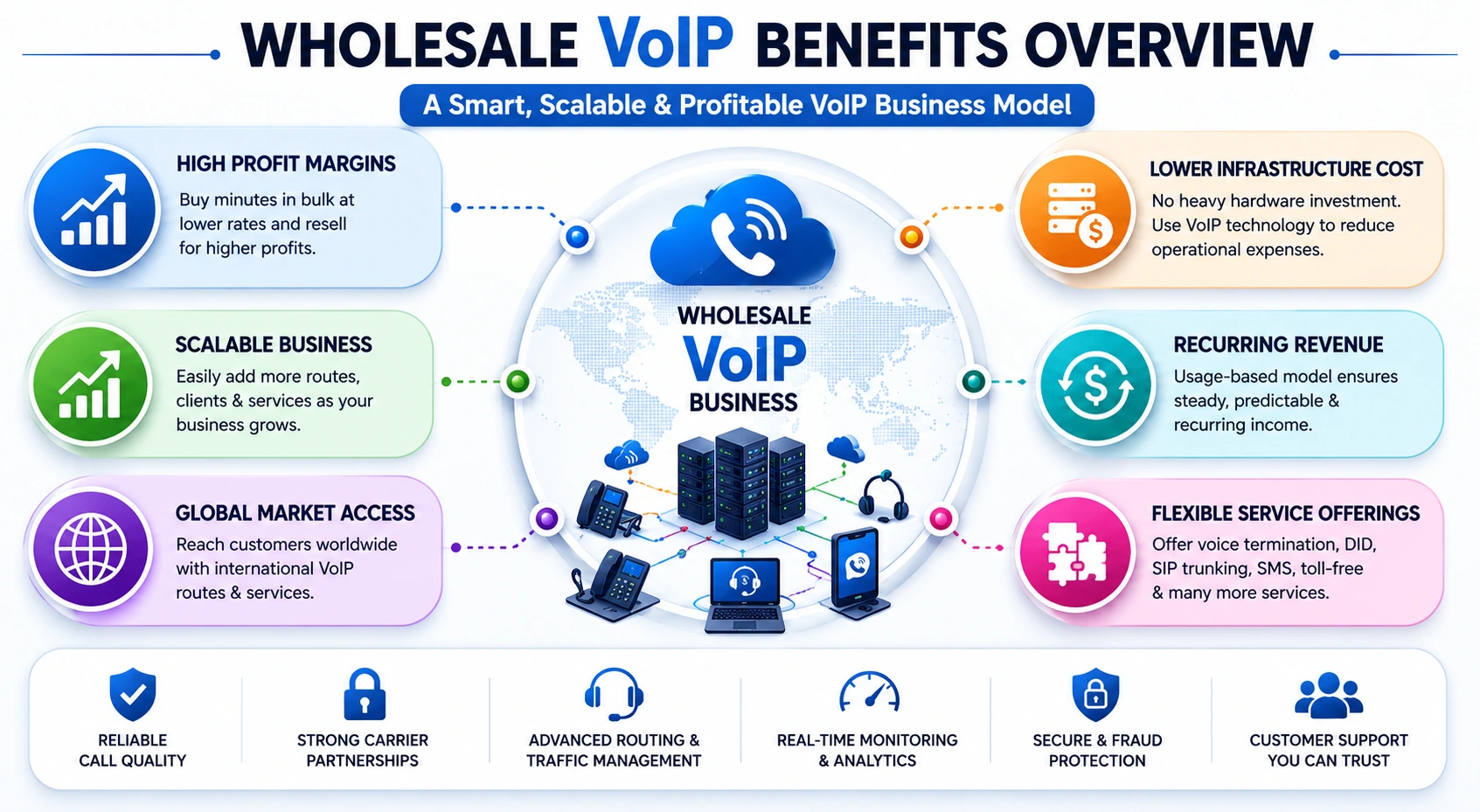
Wholesale VoIP continues to attract entrepreneurs and telecom companies due to its numerous structural advantages. Each benefit addresses a core business challenge that makes this model particularly attractive compared to other telecom ventures.
Industries That Use Wholesale VoIP
Wholesale VoIP services support a wide variety of industries, each with distinct requirements that the model accommodates through its flexible, infrastructure-agnostic architecture.
- Inbound and outbound campaign routing
- Affordable per-minute termination at scale
- International destination coverage
- Wholesale routes for retail resale
- Capacity for business phone systems
- Competitive pricing for end customers
- Expand service without building infrastructure
- Fill coverage gaps via peering arrangements
- Access to premium international routes
- International communication for branches
- High-volume corporate voice traffic
- Cost reduction vs. legacy PSTN lines
- Competitive per-minute rates to any destination
- Calling card and prepaid platform supply
- Multi-country origination and termination
- Branded resale of wholesale voice capacity
- Bundled communication packages
- Managed service provider voice trunking
Challenges in Wholesale VoIP
Despite its advantages, the wholesale VoIP industry presents several real challenges that require deliberate operational strategies. Understanding these before entering the market prevents costly mistakes.
Maintaining Call Quality
Poor voice quality can quickly damage customer relationships in a B2B environment where clients are technical buyers who will notice and report degradation immediately. Providers must continuously monitor latency, packet loss, jitter, and route performance. Quality management remains a top operational priority at every stage of growth.
Fraud Prevention
Telecom fraud represents a significant and ever-evolving threat to VoIP businesses. Common risks include toll fraud, SIP attacks, unauthorized access, and traffic manipulation. Robust security systems — including real-time anomaly detection, call pattern analysis, and automated blocking — are essential to protect revenue and customer trust. A single significant fraud event can wipe out months of profit margin.
Fraud is the number-one risk new wholesale VoIP operators underestimate. Invest in real-time fraud detection systems before launching, not after your first incident. The cost of prevention is always lower than the cost of a breach.
Competitive Pricing Pressure
The wholesale market is highly competitive and margin compression is a constant reality. Providers must balance competitive pricing, service quality, and profitability simultaneously. Success in this environment depends on operational efficiency, strong carrier partnerships that provide better rates, and a differentiated service offering that goes beyond lowest-price positioning.
Regulatory Compliance
Telecommunications regulations vary significantly across countries. Providers must stay continuously informed about licensing requirements, data protection laws, telecom regulations, and international compliance standards in every market they serve. Failure to comply can result in significant legal and financial consequences, including loss of operating licenses.
Tips for Building a Successful Wholesale VoIP Business
Companies entering the wholesale VoIP market should focus on these foundational strategies from day one. These aren't optional enhancements — they are the difference between a sustainable operation and one that struggles to retain customers.
-
Invest in Reliable InfrastructureNetwork reliability directly affects customer satisfaction and retention. Skimping on infrastructure quality is a false economy — the cost of outages and churn always exceeds the savings.
-
Build Multiple Carrier PartnershipsDiversifying carrier relationships improves pricing flexibility and route redundancy. Never rely on a single carrier — they represent a single point of failure for your entire operation.
-
Focus on Call QualityConsistently delivering high-quality voice traffic is your most powerful customer retention tool. In a commodity market, quality is the primary differentiator.
-
Automate Operations EarlyAutomated billing, monitoring, and reporting systems improve efficiency and reduce operational costs. Manual processes don't scale with volume — build automation from the start.
-
Develop Long-Term Client RelationshipsStrong customer support and transparent communication help create recurring business. Wholesale clients are technical buyers — they value responsiveness and honesty over marketing.
-
Diversify Revenue StreamsDon't depend on a single product like international termination. Add SIP trunking, DIDs, toll-free, and SMS to create multiple revenue layers that protect against price erosion in any single segment.
Get the infrastructure right from day one
Wholesale VoIP vs Retail VoIP
Understanding the fundamental differences between wholesale and retail VoIP models helps entrepreneurs choose the right entry point and business structure. These two models serve different markets, require different capabilities, and generate revenue through very different mechanisms.
| Dimension | Wholesale VoIP | Retail VoIP |
|---|---|---|
| Target Customer | Businesses, carriers, resellers | End users, SMBs, consumers |
| Revenue Model | Per-minute margin at volume | Monthly subscription fees |
| Margins Per Unit | Low per-minute, high at volume | Higher per-user margins |
| Scale Required | High — needs large traffic volumes | Lower — profitable at smaller scale |
| Infrastructure | Complex SIP/SBC routing required | Can use wholesale provider's backend |
| Sales Complexity | B2B technical sales cycle | Simpler B2B or B2C sales |
| Customer Count | Fewer, high-value clients | Many smaller accounts |
| Competition Level | Extremely price-competitive | Feature and brand differentiated |
| Global Reach | Full international from day one | Depends on underlying carrier |
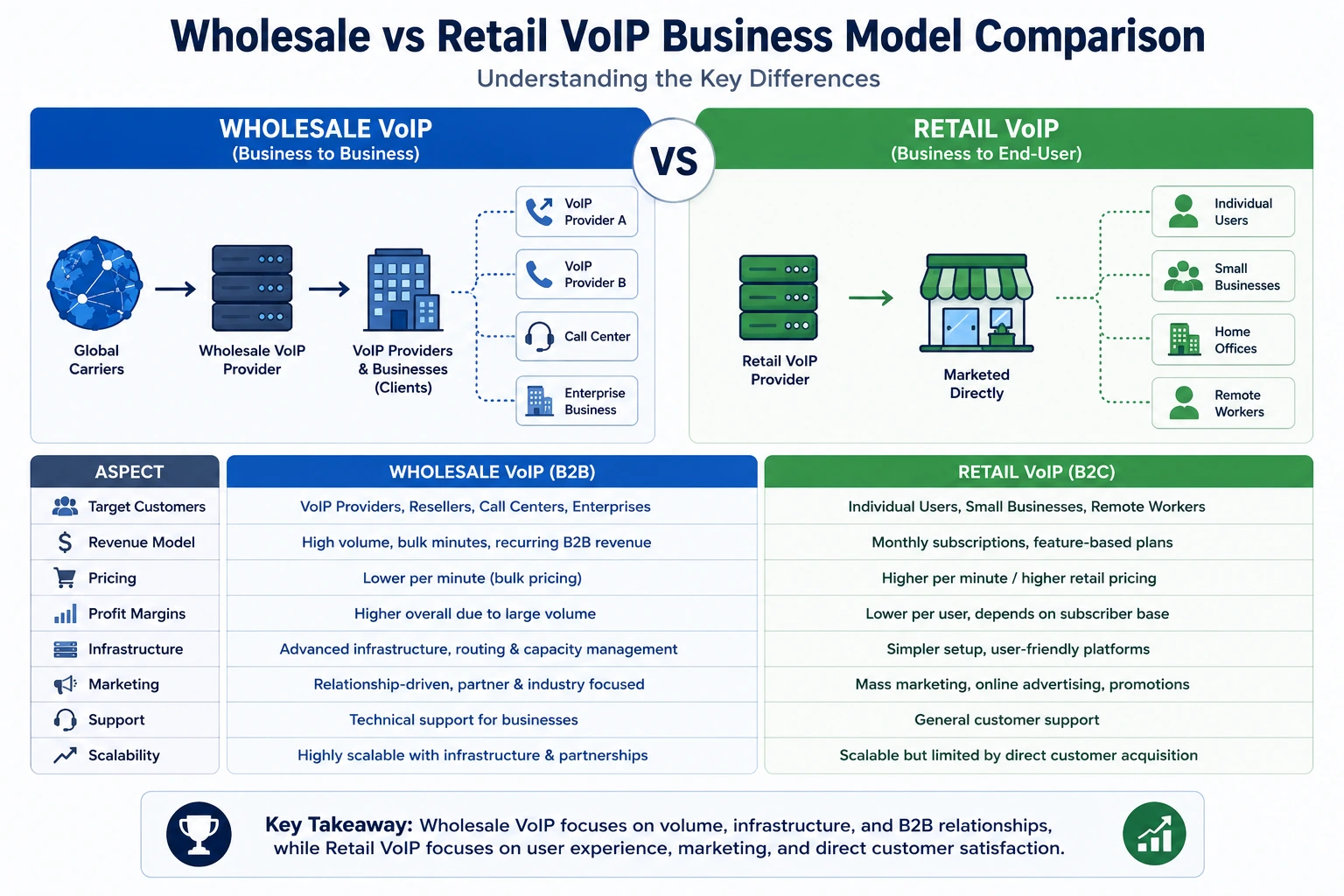
The two models are not mutually exclusive — many successful telecom businesses operate both simultaneously, using wholesale infrastructure to power retail products and capturing margin at multiple layers of the supply chain.
The Future of Wholesale VoIP
The demand for internet-based communication continues to rise as businesses adopt remote work, cloud communications, and international collaboration. This structural growth in demand is a long-term tailwind for wholesale VoIP providers.
Emerging technologies are further reshaping the landscape. Artificial intelligence is being applied to intelligent call routing, real-time fraud detection, and predictive quality management. Cloud telephony platforms are abstracting infrastructure complexity further. Advanced analytics are enabling providers to optimize routes and pricing dynamically in ways that weren't possible with legacy systems.
Businesses that invest in reliable infrastructure, quality service, and strategic carrier partnerships are well-positioned to benefit from the ongoing growth of the industry. The wholesale VoIP market rewards operators who can consistently deliver quality at scale — and that competitive advantage compounds over time.
Frequently Asked Questions
Common questions from entrepreneurs and telecom professionals evaluating the wholesale VoIP business model.
There is no hard minimum, but wholesale VoIP profitability scales with volume. Most carriers require a minimum commitment of 10,000–50,000 minutes per month to qualify for wholesale rates. At under 1 million minutes per month, margins are tight. Businesses typically become meaningfully profitable at 5–10+ million minutes monthly, where the per-minute spread across high volume produces substantial gross revenue.
At minimum, you need a Session Border Controller (SBC) for SIP traffic management, a softswitch or VoIP routing platform, a billing system capable of per-second or per-minute rating, and carrier agreements with at least 2–3 upstream providers for redundancy. Many operators start with hosted/cloud infrastructure to reduce upfront capital and migrate to dedicated hardware as volume grows.
Wholesale VoIP customers are typically acquired through direct B2B outreach to call centers, VoIP service providers, and telecom resellers. Industry events, online telecom forums, and carrier exchanges like Telcobridge and VOIP Exchange are also active sourcing channels. Competitive pricing, route quality demonstrations, and responsiveness to technical evaluations are the primary conversion factors in wholesale sales cycles.
Voice termination refers to delivering outbound calls to their final destination — routing a call placed by your customer to a phone number anywhere in the world. Voice origination (also called inbound origination) refers to receiving calls that arrive at a DID number and delivering them to your customer's SIP endpoint. Wholesale businesses typically offer both, and the margin structures differ between the two services.
Telecom fraud is a very significant risk — the global telecom industry loses billions annually to fraud, and wholesale VoIP providers are prime targets. IRSF (International Revenue Share Fraud), toll fraud, and SIP credential theft can result in tens of thousands of dollars in losses within hours if systems are unprotected. Real-time fraud detection, strict credit limits on new accounts, and continuous monitoring are non-negotiable operational requirements.
Licensing requirements vary significantly by country and jurisdiction. In the United States, wholesale VoIP providers typically need to register as a CLEC (Competitive Local Exchange Carrier) or file appropriate FCC registrations. In the EU and UK, telecommunications licensing frameworks apply. Many countries require an ISP or telecom operator license for commercial voice transit. Always consult a telecom regulatory attorney before launching in any new market.
Conclusion
Wholesale VoIP is a powerful business model that enables providers to purchase voice services in bulk and resell them to businesses around the world. By leveraging bulk pricing, efficient routing technologies, and scalable infrastructure, providers can achieve strong profit margins while serving a diverse customer base across every major industry and geography.
The model offers numerous advantages: lower operational costs, recurring revenue, global reach, and exceptional scalability. While challenges such as fraud prevention, quality management, and market competition are real, companies that focus on infrastructure reliability and customer satisfaction can build highly successful wholesale VoIP operations that compound in value over time.
As digital communication continues to evolve — driven by remote work adoption, cloud communications growth, and the ongoing global convergence of voice and data — wholesale VoIP remains one of the most attractive opportunities for entrepreneurs and telecom providers seeking sustainable growth in the communications industry.
Get carrier-grade SIP infrastructure, competitive wholesale routes, fraud protection, and 24/7 expert support from NexGenVoice.
Custom wholesale agreements and route optimization included.