What Is a Softswitch?
The global telecommunications industry is evolving faster than ever. As businesses expand internationally and communication demands continue to rise, telecom operators face increasing pressure to deliver reliable, scalable, and cost-effective voice services across multiple regions.
Traditional telecom infrastructure is no longer sufficient for handling modern communication requirements. Carriers, VoIP providers, wholesale voice operators, and enterprise communication platforms now rely on advanced software-driven technologies to manage massive volumes of voice traffic efficiently. At the center of this transformation is the softswitch.
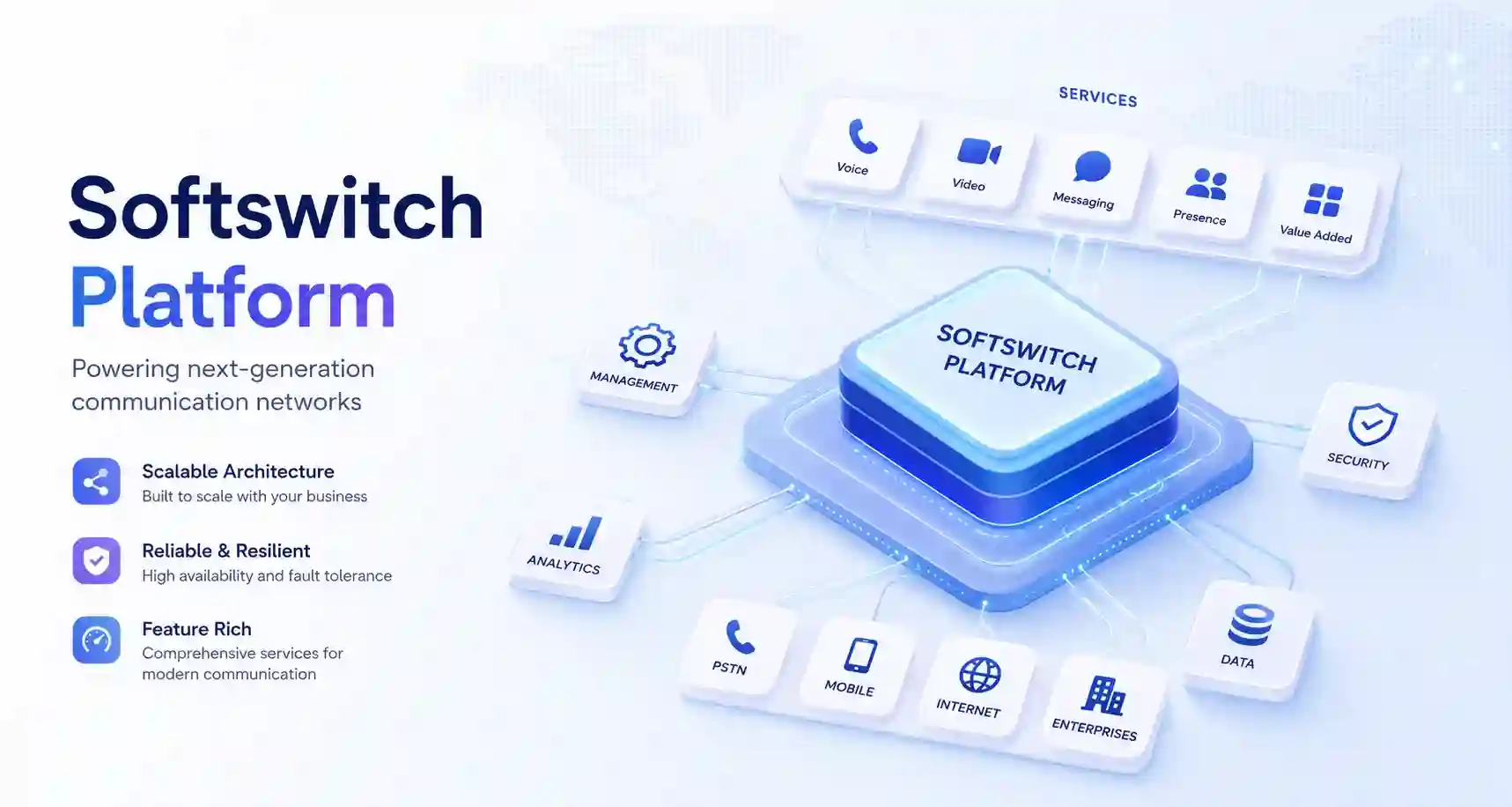
A softswitch is a software-based telecommunications switching platform that manages and routes voice calls over Internet Protocol (IP) networks. Unlike traditional hardware-based telephone switches that require expensive infrastructure and physical connections, a softswitch uses software to control call routing, signaling, billing integration, authentication, and network management.
In simple terms, a softswitch acts as the intelligent control center of a VoIP network. It determines how calls are processed, where they should be routed, and how communication flows between different networks.
Think of a softswitch as the brain of a VoIP network: It handles authentication, decides the optimal call route in real time, manages signaling protocols like SIP, integrates with billing systems, and monitors quality — all through software rather than expensive physical hardware.
Modern telecom operators use softswitches to connect a wide range of platforms and networks:
-
VoIP ProvidersSoftware-driven interconnections between retail and wholesale VoIP platforms.
-
SIP Trunk ProvidersSeamless SIP-based trunk connections for business communication systems.
-
Wholesale Voice CarriersHigh-volume route management between international wholesale operators.
-
PSTN & Mobile NetworksBridging IP-based calls with traditional public switched telephone networks.
-
Contact CentersRouting inbound and outbound call volumes for enterprise contact center operations.
-
UCaaS & Enterprise PlatformsUnified communications solutions including voice, messaging, and video conferencing.
Why Softswitch Solutions Are More Important Than Ever in 2026
The telecom landscape has changed significantly over the last few years. Several trends are driving the growing adoption of advanced softswitch solutions across every segment of the industry.
- Businesses operate across multiple countries simultaneously
- Millions of international calls routed daily
- Quality and reliability expectations continue rising
- Cloud PBX systems depend on flexible VoIP infrastructure
- Remote work solutions require scalable switching platforms
- UCaaS platforms demand high-availability softswitch cores
- Operators need capacity expansion via software configuration
- Customer growth should not require hardware upgrades
- Traffic spikes managed dynamically through cloud resources
- Software replaces expensive physical switching equipment
- Intelligent LCR minimizes per-minute routing costs
- Automation reduces manual network management overhead
How a Softswitch Works
A softswitch serves as the central controller of a voice network. When a user initiates a call, the softswitch performs several critical functions in rapid succession to ensure the call is authenticated, routed, managed, and billed correctly — all in real time.
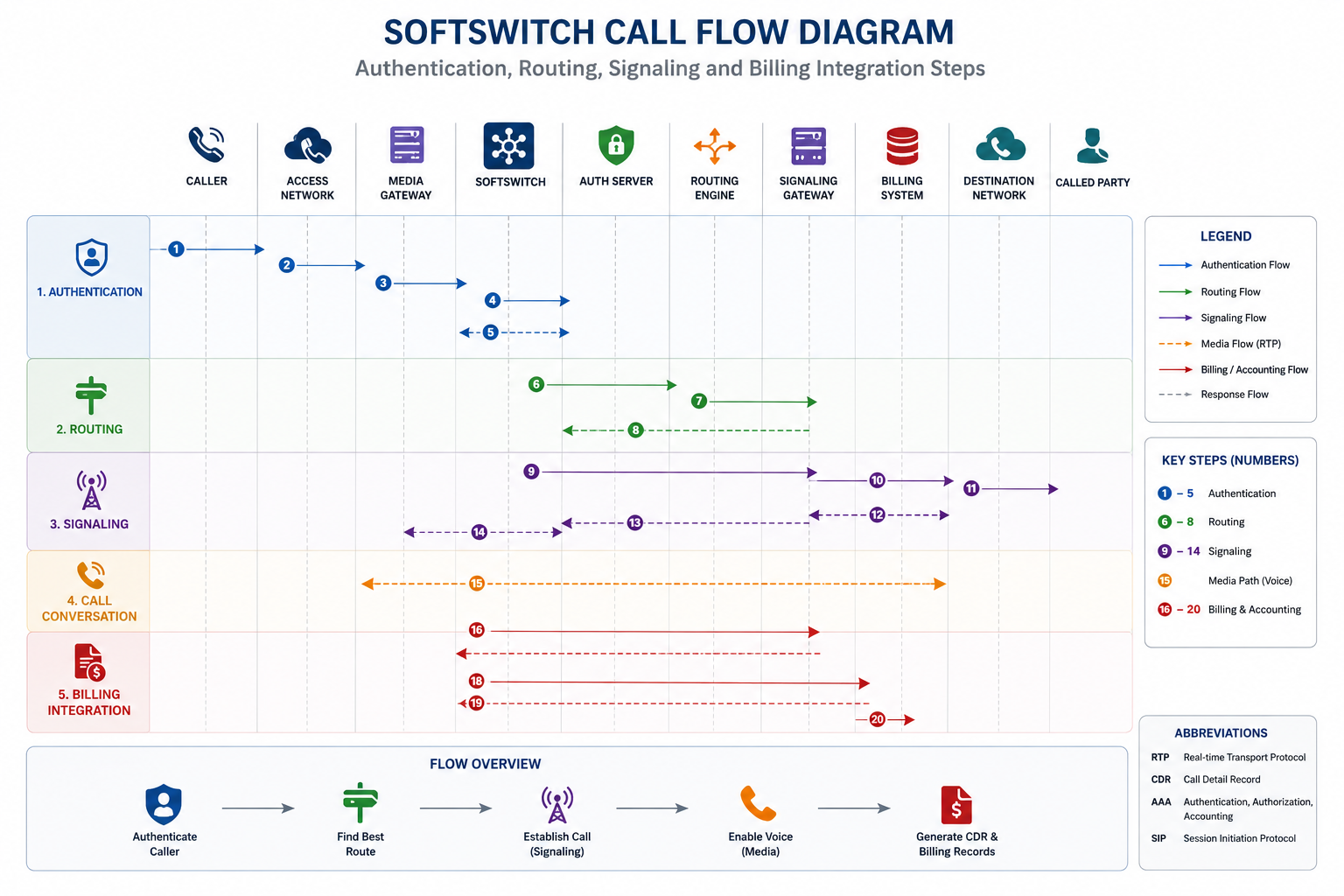
1. Call Authentication
The system verifies the caller's credentials and ensures that the connection request is legitimate. This step is essential for preventing unauthorized usage and protecting against SIP-based fraud attempts that are common in VoIP environments.
2. Call Routing
The softswitch analyzes available routes and selects the most efficient path based on multiple real-time factors. This intelligent routing is one of the most valuable capabilities of modern softswitch platforms:
- Cost per minute to each available carrier
- Current quality metrics and call completion rates
- Destination country and number type
- Carrier availability and capacity
- Real-time network congestion levels
3. Signaling Management
Protocols such as SIP (Session Initiation Protocol) are managed by the softswitch to establish, maintain, and terminate calls. The platform handles all SIP signaling exchanges between endpoints, carriers, and intermediate network elements throughout the duration of every call.
4. Billing Integration
The platform records call details in real time and communicates with billing systems for accurate charging and reporting. Every call detail record (CDR) is captured, stored, and made available for customer invoicing, revenue reconciliation, and regulatory reporting.
5. Quality Monitoring
Modern softswitches continuously monitor network performance to ensure optimal voice quality across all active calls. This includes real-time tracking of latency, jitter, packet loss, and call completion rates — with automatic route switching triggered when quality falls below configured thresholds.
This automation allows telecom providers to manage enormous call volumes with minimal manual intervention. A well-configured softswitch can handle thousands of concurrent calls while making routing decisions in milliseconds — something that would be impossible with legacy hardware-based switching equipment.
Key Features of Modern Softswitch Solutions
Today's telecom operators require far more than basic call switching capabilities. Leading softswitch platforms include a comprehensive set of advanced features designed to support high-volume commercial voice operations at global scale.
Ready to deploy carrier-grade softswitch infrastructure?
NexGenVoice provides fully managed SIP infrastructure with intelligent routing and 24/7 NOC support.
Benefits of Softswitch Solutions for Telecom Companies
Adopting a modern softswitch platform delivers measurable advantages across every dimension of a telecom operation — from cost structure and service quality to market agility and long-term competitive positioning.
How Telecom Companies Use Softswitches to Scale Globally
Successful telecom operators use softswitch platforms as the foundation of their international voice networks. The technology enables capabilities that would be prohibitively expensive or technically impossible with legacy hardware-based infrastructure.
Managing International Voice Traffic
Global providers often route calls through multiple carriers across different regions. A softswitch automatically determines the optimal route based on real-time cost and quality parameters. This continuous route optimization across dozens of carrier relationships happens in milliseconds for every single call.
Expanding Into New Markets
Instead of building physical infrastructure in every country, operators can connect to local carriers through SIP interconnections. This dramatically reduces the capital expenditure required for international market entry and allows new destinations to be activated within hours rather than months.
Supporting Wholesale Voice Services
Wholesale carriers process millions of minutes each month across thousands of destinations. Softswitches enable automated routing, traffic balancing, billing, and carrier management at the scale required for commercial wholesale voice operations.
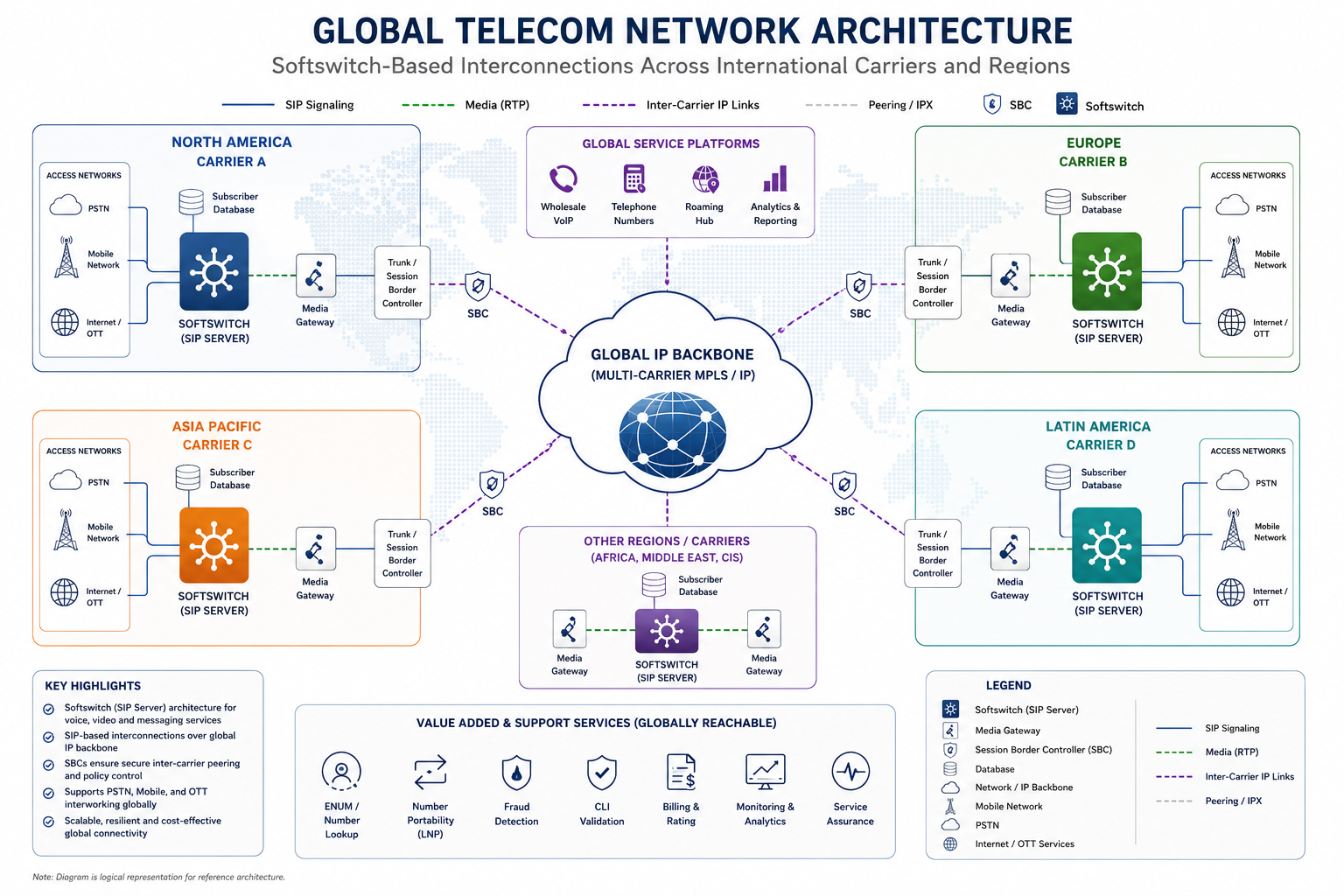
Powering SIP Trunking Services
Many businesses are migrating from traditional phone systems to SIP trunking. Softswitch platforms allow telecom providers to deliver scalable, reliable SIP services efficiently — serving hundreds or thousands of business customers from a single centralized platform.
Enabling Unified Communications
Modern communication platforms combine voice, messaging, video conferencing, and collaboration tools. Softswitches provide the connectivity layer that makes these integrated services possible, bridging different protocols and network types into a unified communication fabric.
Challenges Telecom Providers Face Without a Softswitch
Organizations that rely on outdated telecom infrastructure often face significant operational and competitive disadvantages as communication demands continue to grow.
| Challenge Area | Legacy Hardware Infrastructure | Modern Softswitch Platform |
|---|---|---|
| Scalability | ✗ Limited by hardware | ✓ Software-configurable |
| Operational Costs | ✗ High hardware overhead | ✓ Software-driven savings |
| Route Optimization | ✗ Manual configuration | ✓ Automated LCR |
| Fraud Prevention | ✗ Reactive detection only | ✓ Real-time automated blocking |
| Service Deployment | ✗ Weeks of provisioning | ✓ Hours or minutes |
| Call Quality | ✗ Static routing paths | ✓ Dynamic quality-based routing |
| Multi-Carrier Support | ✗ Complex physical tie-lines | ✓ SIP-based interconnections |
As communication demands continue growing, these limitations become increasingly difficult to manage. This is why most modern telecom operators have adopted advanced softswitch solutions as a core part of their infrastructure strategy.
Emerging Softswitch Trends in 2026
The softswitch market continues to evolve alongside broader telecom innovations. Several major trends are shaping the future of voice network management and redefining what operators can expect from their switching infrastructure.
AI-Powered Routing
Artificial intelligence is improving route optimization by analyzing real-time network performance and predicting congestion before it occurs. AI-driven routing systems can learn from historical call data to continuously improve route selection decisions, resulting in better quality and lower costs over time.
Cloud-Native Softswitch Platforms
Cloud deployment provides greater flexibility, scalability, and disaster recovery capabilities than on-premise installations. Cloud-native softswitch platforms can scale up or down dynamically based on traffic demand — paying only for the capacity actually used at any given time.
Enhanced Security Frameworks
Advanced fraud detection systems are becoming standard features as telecom fraud grows more sophisticated. Next-generation security frameworks combine behavioral analytics, machine learning, and real-time threat intelligence to identify and block fraudulent traffic patterns that traditional rule-based systems miss.
Looking for a future-ready voice infrastructure partner?
NexGenVoice combines AI-enhanced routing with enterprise-grade fraud protection and cloud-native flexibility.
Integration with Unified Communications
Softswitch platforms are increasingly integrating with UCaaS and CPaaS solutions to support modern business communication requirements. This integration allows voice services to be delivered as a seamless component of broader communication and collaboration platforms.
Automation and Self-Healing Networks
Automation technologies enable networks to detect and resolve issues with minimal human intervention. Self-healing capabilities allow softswitch platforms to automatically reroute traffic around failed components, reducing mean time to recovery and improving overall service availability for customers.
Choosing the Right Softswitch Solution
When evaluating a softswitch platform for your telecom operation, the selection process should be driven by your current needs and long-term growth objectives. The right solution can significantly impact network performance, customer satisfaction, and long-term profitability.
-
Scalability RequirementsAssess your current traffic volumes and projected growth to ensure the platform can grow with your business without costly migrations.
-
Routing CapabilitiesEvaluate LCR sophistication, quality-based routing options, failover logic, and the number of concurrent routes the platform can manage.
-
Billing IntegrationConfirm the platform supports your billing model — prepaid, postpaid, or hybrid — with real-time CDR generation and accounting system compatibility.
-
Security FeaturesReview fraud detection capabilities, rate limiting controls, IP-based access management, and the vendor's track record on security updates.
-
Multi-Carrier SupportEnsure the platform can connect to multiple carriers simultaneously and supports standard SIP interconnection protocols for flexibility.
-
Reporting & AnalyticsLook for comprehensive dashboards, CDR access, quality metrics, financial reporting, and API access for custom integrations.
-
Cloud Deployment OptionsConsider whether the platform offers cloud-native deployment or hosted managed services alongside traditional on-premise installations.
-
Technical Support AvailabilityVerify the vendor's support hours, response time commitments, and escalation procedures — especially critical for 24/7 voice operations.
Frequently Asked Questions
Common questions about softswitch solutions and how they power modern telecom voice networks.
A Class 4 softswitch handles transit traffic between carriers — it routes wholesale voice traffic from one network to another without directly serving end users. A Class 5 softswitch connects directly to end users and provides retail features such as voicemail, call forwarding, caller ID, and SIP registration. Many commercial platforms combine both functions, and the terminology is sometimes used loosely in the industry.
Yes. Modern softswitches are designed to interwork between IP-based SIP traffic and traditional PSTN networks. They can connect to PSTN through VoIP gateways or media gateways that convert between TDM/SS7 signaling and SIP. This interoperability is essential for operators who need to serve both legacy and modern communication environments during the ongoing transition to all-IP networks.
Capacity varies significantly based on the platform and server resources. Enterprise-grade softswitch platforms can handle anywhere from a few thousand to hundreds of thousands of concurrent calls depending on the hardware configuration and software architecture. Cloud-native platforms can scale dynamically to meet traffic demands without hard limits, making them suitable for carriers managing millions of minutes per month.
Least Cost Routing (LCR) is an automated decision-making process within the softswitch that evaluates all available carrier routes for a given destination and selects the most economical option that meets quality thresholds. When a call arrives, the softswitch looks up the dialed number, retrieves the routing table for that destination, compares available carrier rates and quality metrics, and sends the call to the cheapest qualifying carrier. Quality-based LCR also factors in call completion rates and voice quality scores to avoid low-cost routes that degrade the customer experience.
No — they serve different functions, though they are often deployed together. A softswitch is the core call control platform that makes routing, billing, and signaling decisions. A Session Border Controller (SBC) sits at the edge of the network and handles security, NAT traversal, protocol normalization, and media quality. In most commercial deployments, traffic passes through the SBC at the network border before being processed by the softswitch for routing logic.
Deployment timelines vary by platform and hosting model. Cloud-hosted or managed softswitch solutions can be provisioned and operational within days to a few weeks, as the underlying infrastructure already exists. On-premise deployments typically take longer — from several weeks to a few months — depending on hardware procurement, data center preparation, and configuration complexity. Working with an experienced provider like NexGenVoice significantly accelerates deployment timelines and reduces configuration risk.
Conclusion
Softswitch technology has become the backbone of modern telecommunications infrastructure. As global voice traffic continues to grow and communication networks become increasingly complex, telecom providers need scalable, intelligent, and cost-effective solutions to remain competitive.
By enabling advanced call routing, real-time traffic management, multi-carrier connectivity, fraud prevention, and seamless scalability, softswitch solutions help telecom companies efficiently manage global voice networks while reducing operational costs.
In 2026 and beyond, organizations that invest in modern softswitch platforms will be better positioned to deliver high-quality communication services, expand internationally, and adapt to the rapidly changing telecom landscape. Whether you're a wholesale voice provider, VoIP operator, SIP trunking company, or enterprise telecom business, implementing the right softswitch solution is one of the most important strategic decisions for sustainable growth and long-term success.
Get carrier-grade SIP infrastructure, intelligent LCR routing, fraud protection, and 24/7 expert support from NexGenVoice.
Custom wholesale agreements and route optimization included.