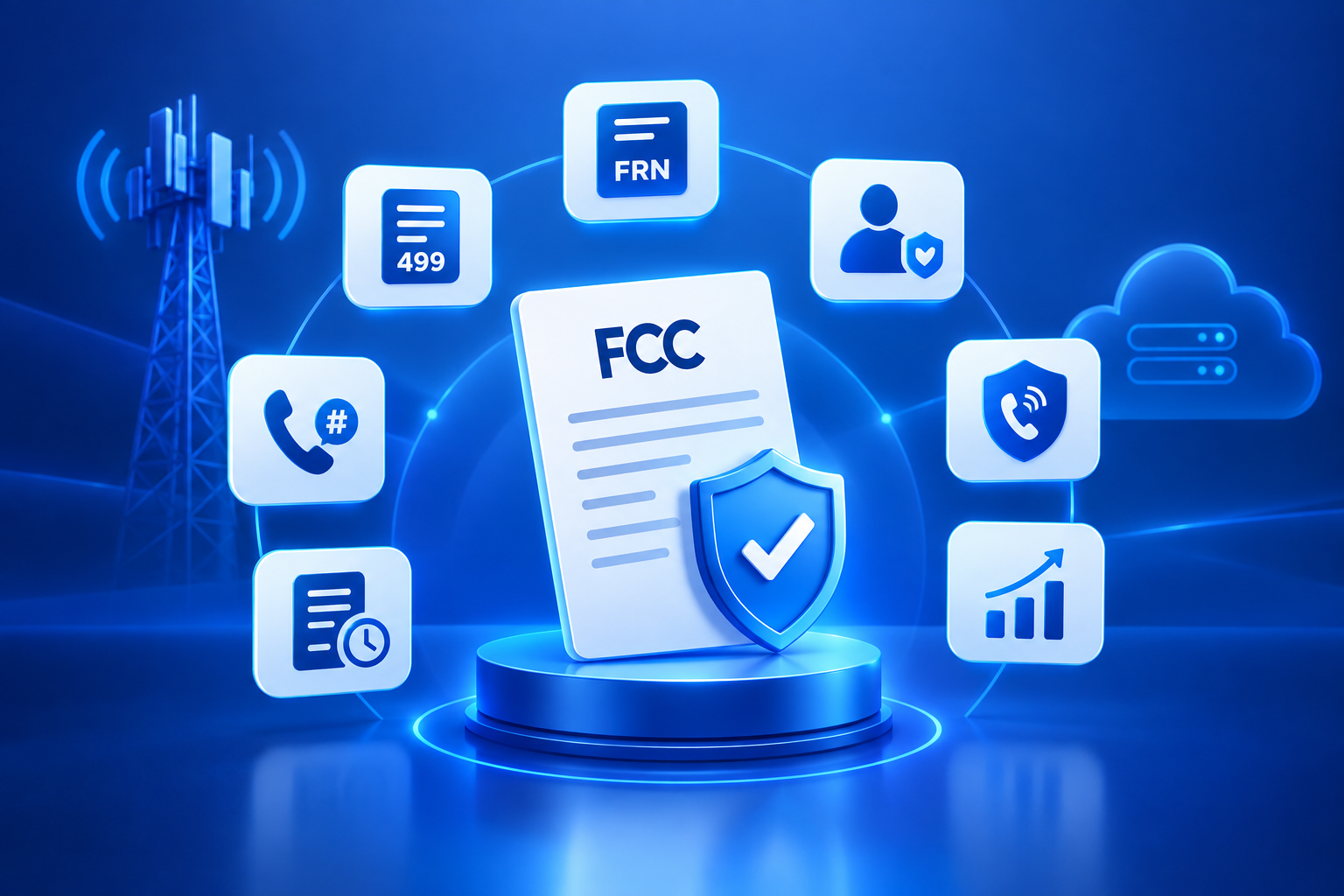
For a U.S. telecommunications provider, some regulatory requirements are large and obvious. Others are small but still important. The D.C. Agent named on FCC Form 499-A belongs in the second group.
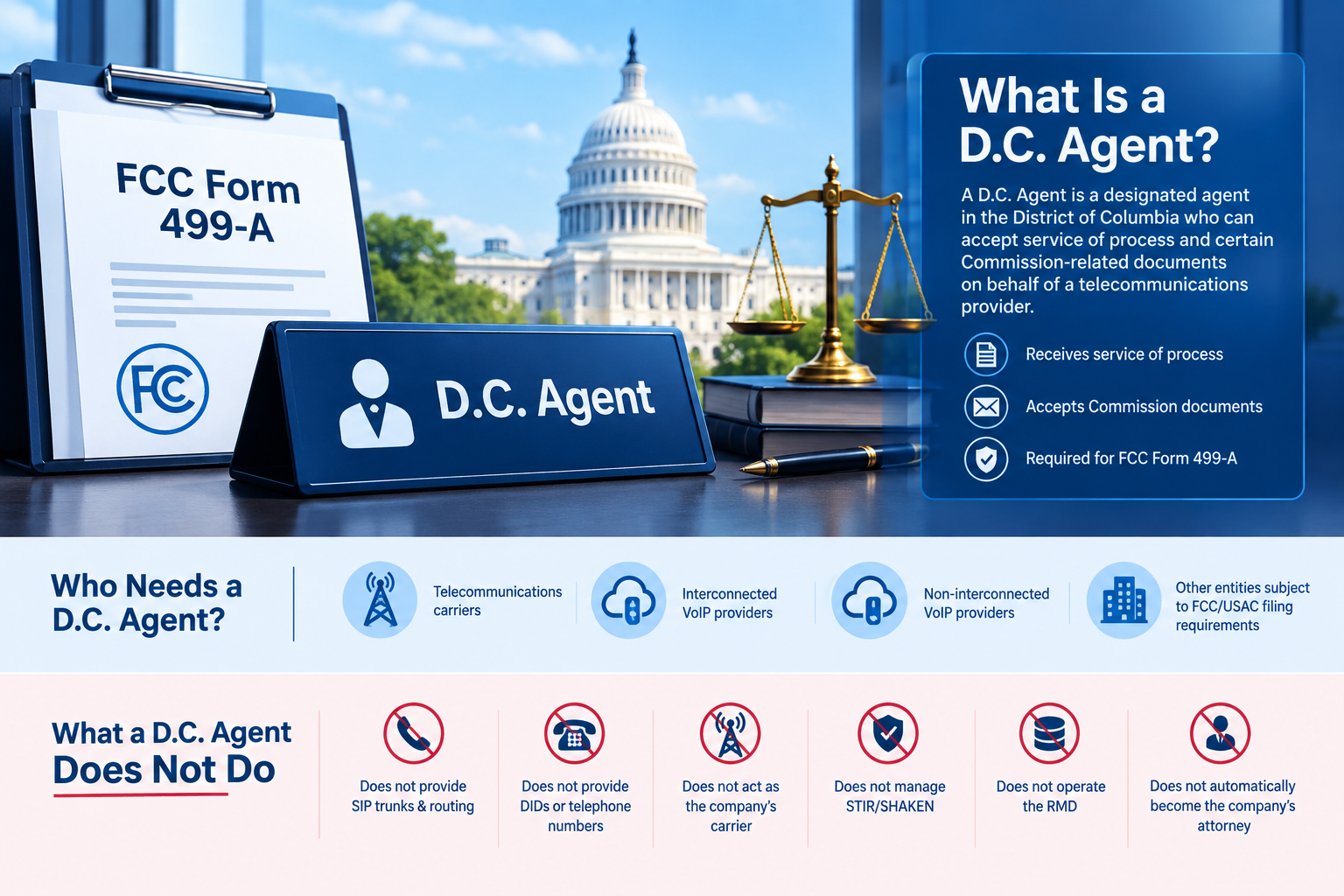
A D.C. Agent is a designated agent in the District of Columbia who can accept service of process and certain Commission-related documents on behalf of a telecommunications provider subject to the applicable FCC Form 499-A requirements.
The current 2026 FCC Form 499-A instructions state that carriers, interconnected VoIP providers and non-interconnected VoIP providers must provide information for their designated D.C. Agent. The instructions also state that new carriers and VoIP providers must identify an agent for service of process. A D.C. Agent is therefore part of a provider's regulatory registration information.
This guide explains what the role is, who it applies to, and how it differs from the FCC FRN, the 499 Filer ID, a state registered agent, an attorney, the RMD and STIR/SHAKEN.
01What Is a D.C. Agent?
A D.C. Agent is a designated agent in the District of Columbia who can accept service of process and certain Commission-related documents on behalf of a telecommunications provider. The requirement is tied to FCC Form 499-A, so it applies to providers subject to that filing.
It is especially relevant to telecommunications carriers, interconnected VoIP providers, non-interconnected VoIP providers and other entities subject to the applicable FCC/USAC filing requirements.
In practice, the D.C. Agent is one entry in a provider's regulatory file, sitting alongside the FRN, the 499 Filer ID and other registration details.
Why does the FCC require a D.C. Agent?
Telecommunications companies can operate across state lines and may not have a physical office in Washington, D.C. A federal regulator nevertheless needs a reliable way to serve documents. A designated D.C. Agent provides a known point for service of process.
The purpose is not to operate the company's telecom network. The purpose is legal and regulatory service. This distinction is important.
What a D.C. Agent does not do
The agent's role is focused on receiving service of process and applicable Commission documents.
02Who Needs a D.C. Agent?
The current FCC Form 499-A instructions specifically address carriers, interconnected VoIP providers and non-interconnected VoIP providers. The 2026 instructions also explain that covered providers must designate a single agent for service of process in D.C. for Commission business.
The requirement is especially relevant to:
- ✓telecommunications carriers
- ✓interconnected VoIP providers
- ✓non-interconnected VoIP providers
- ✓other entities subject to the applicable FCC/USAC filing requirements
What information is required for the agent?
The instructions require the designated D.C. Agent's:
- ✓company or person name
- ✓business address
- ✓email address
- ✓telephone or voicemail number
D.C. Agent and international VoIP companies
International companies entering the U.S. voice market should pay particular attention to this requirement. A company located outside the United States may not have a traditional Washington, D.C. office. That does not automatically eliminate the applicable requirement.
The FCC's current Form 499-A instructions specifically address carriers and VoIP providers and require designated D.C. Agent information where applicable. This is one reason U.S. regulatory preparation should happen before launching a U.S.-focused telecommunications service. The requirement depends on the company's regulatory status and applicable FCC rules, so international providers should review the current requirements carefully.
03D.C. Agent vs Registered Agent vs Attorney
These terms are often confused, but they describe different roles.
| Role | What it is |
|---|---|
| D.C. Agent | A designated agent associated with FCC Form 499-A requirements who can accept service of process and Commission documents. |
| Registered agent | Generally associated with state corporate law and entity registration. |
| Attorney | Provides legal advice and representation. |
A company can therefore have a registered agent in a state, a D.C. Agent for FCC purposes, legal counsel, a compliance contact and a corporate officer. These roles may be performed by different people or organizations.
D.C. Agent vs attorney
A D.C. Agent is not automatically the company's attorney. An agent can receive service of process. An attorney provides legal advice and representation. A company should not assume that appointing a D.C. Agent creates an attorney-client relationship. If legal advice is required, the company should engage qualified counsel.
D.C. Agent vs state registered agent
A telecommunications company can have multiple agent relationships. For example, a Delaware registered agent for corporate registration, a Texas registered agent for state qualification, and a D.C. Agent for the applicable FCC Form 499 requirements. These are not automatically the same legal role.
04What the Agent Receives & What Goes Into Form 499-A
The FCC Form 499-A instructions explain that service on the designated agent may include several types of Commission communications.
Service may include:
- ✓notices
- ✓process
- ✓orders
- ✓decisions
- ✓requirements of the Commission
The designated agent must be available to accept service as required by the applicable rules, which makes the agent's contact information important. If the company lists an agent who no longer operates at the address or no longer accepts service, the regulatory record can become inaccurate.
What information goes into Form 499-A?
The current Form 499-A process includes D.C. Agent information. USAC's registration guidance tells new providers to prepare contact information for the company and for the person or company designated as the D.C. Agent for Service of Process.
The FCC instructions identify information including:
- ✓agent name
- ✓business address
- ✓telephone or voicemail number
The company should ensure that this information is accurate before submission.
05Appointing & Updating Your D.C. Agent
A new provider should determine its D.C. Agent arrangement before completing its FCC/USAC registration process, if the requirement applies. The 2026 FCC instructions state that new carriers and VoIP providers must identify an agent for service of process and register with the FCC within 30 days of providing service. Because filing requirements can change, confirm the current rule and instructions at the time of registration.
A simplified sequence. Always verify the current FCC Form 499-A instructions before filing.
What happens if the agent information changes?
A provider should not leave old agent information in its regulatory records. The current FCC Form 499-A instructions state that carriers and covered VoIP providers must notify USAC within one week if the contact information changes for their D.C. Agent. Companies should therefore treat D.C. Agent information as maintained regulatory data rather than a one-time form field.
Why outdated agent information becomes a compliance problem
Imagine a company registered a D.C. Agent two years ago. The company changes service providers and the original agent stops handling service, but the company does not update its Form 499 information. The regulatory database still contains the old agent. This creates an avoidable compliance problem.
Can a company's employee be the D.C. Agent?
The company should determine whether its proposed agent satisfies the applicable FCC requirements. The Form 499-A instructions specify that the designated agent must accept service of process for the covered provider's Commission business. A company should not simply enter an employee's name without ensuring that the person or entity is appropriate and available to perform the role.
For many businesses, a professional registered-agent or specialized telecom compliance service may be used. The specific arrangement should be reviewed against current requirements.
What makes a good D.C. Agent arrangement?
Availability
The agent should be able to receive service during required business hours.
Accurate information
The name, address, email and phone information must remain current.
Clear responsibility
The company should know who monitors incoming documents.
Prompt forwarding
The agent should promptly notify the company when important documents are received.
Recordkeeping
The company should retain evidence of the current agent arrangement.
07Compliance Checklist & Records
Keeping D.C. Agent information accurate is simple but valuable operational hygiene.
D.C. Agent compliance checklist
A VoIP provider can maintain the following checklist:
- ✓agent name verified
- ✓agent address verified
- ✓agent email verified
- ✓agent telephone number verified
- ✓agent has agreed to accept service
- ✓agent arrangement documented
- ✓Form 499-A information matches current records
- ✓internal compliance team knows the agent
- ✓calendar reminder created for periodic review
- ✓changes reported according to applicable requirements
What a recurring review should cover
A good compliance program includes a recurring review of:
- ✓legal name
- ✓DBA
- ✓FRN
- ✓Filer ID
- ✓company address
- ✓officer information
- ✓D.C. Agent
- ✓telecommunications activities
- ✓RMD information
- ✓other applicable regulatory information
How to build a telecom compliance record
A professional provider can create a compliance folder containing:
| Folder | What to keep |
|---|---|
| Corporate | Certificate of formation, EIN, legal name, DBA. |
| FCC | FRN, CORES records, regulatory correspondence. |
| USAC | 499 Filer ID, Form 499-A, Form 499-Q where applicable, E-File records. |
| Numbering | OCN, Company Code, SPID, DID records. |
| RMD | RMD filing, certification, robocall mitigation plan, updates. |
| STIR/SHAKEN | Provider authorization, certificate information, certificate lifecycle records, signing policies, customer verification. |
| D.C. Agent | Agent agreement, agent contact details, confirmation of acceptance, change history. |
This structure can make audits and carrier onboarding much easier.
08Common D.C. Agent Mistakes
Confusing the D.C. Agent with a registered agent
They can serve different purposes and are not automatically the same legal role.
Treating the agent as legal counsel
A D.C. Agent is not automatically an attorney.
Listing an agent without confirming availability
The agent must be able to perform the required role.
Forgetting to update changed information
Current FCC instructions specify an update timeframe for changes in D.C. Agent contact information.
Assuming the D.C. Agent equals the Filer ID
They are unrelated identifiers and functions.
Treating the D.C. Agent as a technical telecom function
It is a legal and regulatory service function.
09Why It Matters to NexGen Voice
For a company operating in VoIP, SIP trunking, DID numbers and wholesale telecommunications, regulatory credibility can be an important part of customer and carrier relationships. A professional VoIP provider should understand:
- ✓FCC FRN registration
- ✓499 Filer ID obligations
- ✓the D.C. Agent requirement
- ✓the one-week update rule for agent changes
- ✓RMD certification
- ✓STIR/SHAKEN arrangements
- ✓OCN, Company Code and SPID
- ✓ongoing recordkeeping
The D.C. Agent's role is specifically related to service of process and Commission business. The agent does not become responsible for a provider's network or customer service, which is why it should be treated as one component of a broader compliance program.
This guide is educational. It does not describe NexGen Voice's own Filer ID, RMD registration, D.C. Agent arrangement, or other regulated filings. For questions about a specific service, contact our team.
10Frequently Asked Questions
A D.C. Agent is a designated agent in the District of Columbia for service of process for covered telecommunications providers under the applicable FCC requirements.
The current FCC Form 499-A instructions specifically require carriers, interconnected VoIP providers and non-interconnected VoIP providers to provide D.C. Agent information.
Not necessarily. They can serve different legal and regulatory purposes.
Not automatically. A D.C. Agent receives service of process; an attorney provides legal advice and representation.
No. The Filer ID identifies the company in the Form 499 system, while the D.C. Agent is a designated recipient for service of process.
The current Form 499-A instructions state that covered providers must notify USAC within one week when the D.C. Agent contact information changes.
No. STIR/SHAKEN is a separate caller-ID authentication framework.
No. The D.C. Agent's role is legal and regulatory service, not network operation.
The requirement depends on the company's regulatory status and applicable FCC rules. International providers serving the U.S. market should review the current FCC requirements carefully.
11Conclusion
A D.C. Agent is a small but important part of the regulatory infrastructure surrounding U.S. telecommunications providers. For covered carriers and VoIP providers, it provides a designated point for service of process and relevant Commission business.
The D.C. Agent should not be confused with the FCC FRN, the 499 Filer ID, the OCN, the SPID, a registered agent, an attorney, the RMD or STIR/SHAKEN. Each serves a different purpose.
For NexGen Voice and other telecommunications companies, keeping D.C. Agent information accurate should be part of a broader compliance-management process. As FCC and USAC requirements evolve, companies should verify current instructions before relying on a static checklist.
.webp)