The STIR/SHAKEN Policy Administrator (STI-PA) is a key component of the trust framework used to support caller-ID authentication in the United States.
STIR/SHAKEN is not simply a software feature that a VoIP provider switches on. It depends on a larger trust architecture involving governance, service-provider authorization, policy administration, Service Provider Code tokens, Certification Authorities, digital certificates, call signing and signature verification.
In the United States, iconectiv operates the STI-PA function. iconectiv describes its role as the U.S. Secure Telephone Identity Policy Administrator and explains that it supports the SHAKEN trust framework.
Understanding the STI-PA is useful for carriers, VoIP providers, resellers and telecom compliance teams because it explains how a service provider moves from being a telecommunications company to being an authorized participant in the caller-ID authentication trust framework.
01Why STIR/SHAKEN Needs a Policy Administrator
A digital-signature system needs trust. Imagine that any company could create a certificate and claim, "We are an authorized U.S. voice provider." A receiving carrier would have no reliable way to know whether that claim was legitimate.
The STIR/SHAKEN ecosystem therefore needs a trusted governance structure. The basic concept moves from governance to policy, to provider authorization, to a certificate authority, to a certificate, and finally to call signing.
The Policy Administrator is part of that trust structure. It helps establish who is authorized to participate and how certificates are requested and managed within the framework.
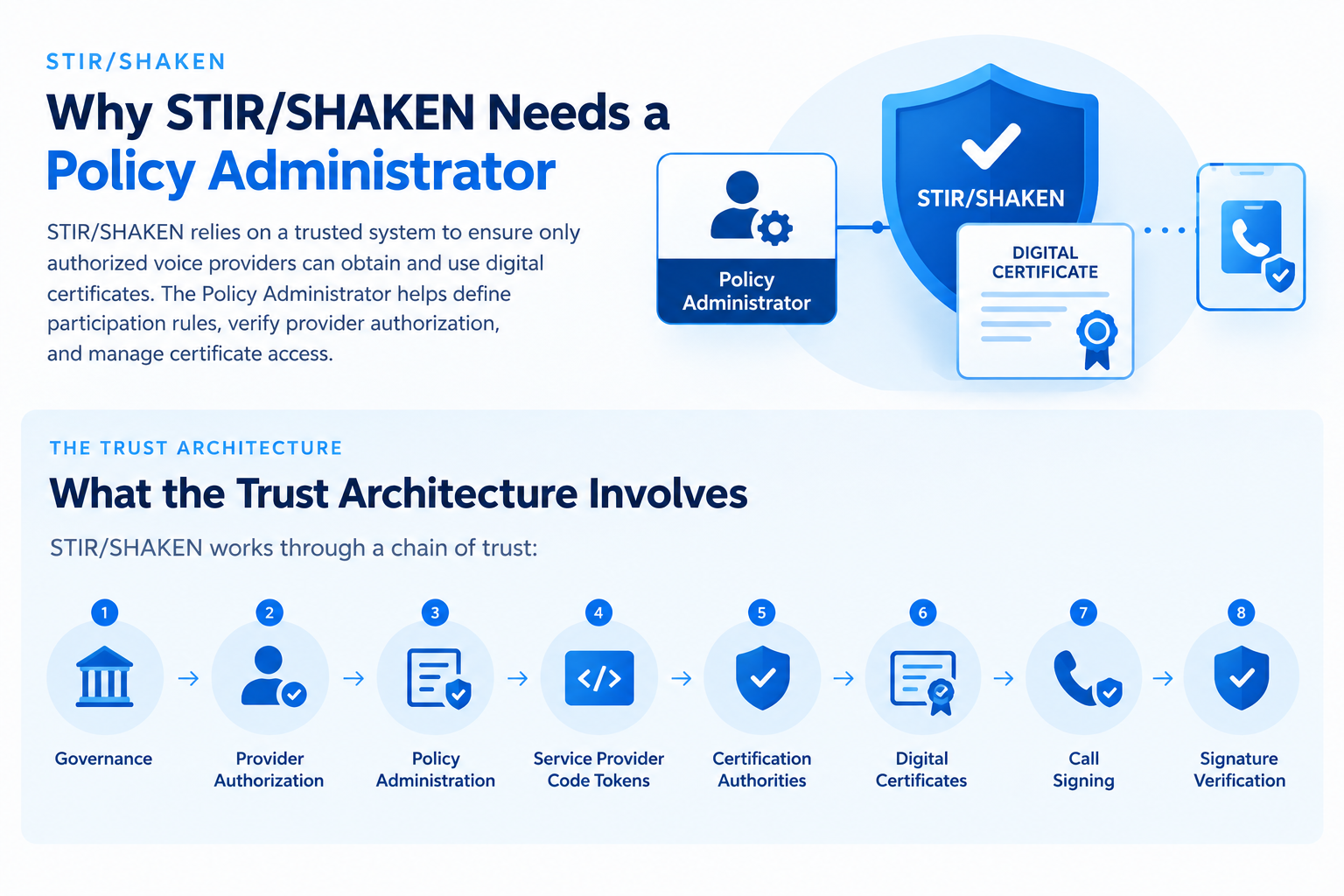
What the trust architecture involves
STIR/SHAKEN is not a switch a VoIP provider simply flips on. It depends on a larger trust architecture involving:
- ✓governance
- ✓service-provider authorization
- ✓policy administration
- ✓Service Provider Code tokens
- ✓Certification Authorities
- ✓digital certificates
- ✓call signing
- ✓signature verification
02What Is the STI-PA?
iconectiv currently serves as the U.S. STI-PA. Its role exists within the broader Secure Telephone Identity Governance Authority ecosystem, which includes multiple organizations and functions that should not be confused with one another.
The STI-PA performs several trust-framework functions. iconectiv's STI-PA materials describe its role in the STIR/SHAKEN ecosystem and its handling of Service Provider Code tokens. The important concept is that the STI-PA establishes trust and authorization within the framework — it does not simply act as another SIP carrier.
What the STI-PA actually does
At a high level, the STI-PA's functions include:
- ✓service-provider authorization
- ✓management of provider trust information
- ✓SPC token processes
- ✓interaction with authorized Certification Authorities
- ✓policy enforcement within its assigned role
- ✓supporting certificate authorization workflows
03STI-GA, STI-PA & STI-CA: Who's Who
The Secure Telephone Identity Governance Authority (STI-GA) is part of the governance structure for the STIR/SHAKEN ecosystem. The governance layer establishes the rules and policies under which the trust framework operates. ATIS's STI-GA documentation uses terminology including the FCC, SHAKEN, SIP, Service Provider, Service Provider Code, Policy Management Authority and Public Key Infrastructure — illustrating that STIR/SHAKEN is an industry governance and cryptographic framework rather than merely a carrier-specific feature.
Comparing the trust-framework roles
| Component | Main function |
|---|---|
| STI-GA | Sets the governance rules and policies for the STIR/SHAKEN ecosystem. |
| STI-PA | Policy/trust administration and provider authorization; manages SPC token processes. |
| STI-CA | An authorized Certification Authority that issues digital certificates. |
| Service Provider | Signs eligible calls using its certificate. |
| Terminating Provider | Verifies the signature and evaluates the attestation. |
This table should not be interpreted as a complete technical specification, but it is useful for understanding how the architecture is organized.
04SPC Tokens & the Certificate Process
The Service Provider Code (SPC) is an important identifier in the STIR/SHAKEN trust framework. It is used as part of the process by which a service provider is authorized to obtain certificates — the provider does not simply generate a certificate independently; it participates in the trust system.
The SPC token is associated with the provider's authorization to obtain a certificate. It should not be confused with the certificate itself: the token helps establish authorization, while the certificate provides the cryptographic signing credentials.
A simplified view of the authorization process: an eligible service provider works with the STI-PA to obtain an SPC token, which supports a request for a certificate from an authorized STI-CA.
Does iconectiv issue the certificate?
The safest technical explanation is that the STI-PA and STI-CA functions are different. The Policy Administrator manages the policy/trust process and authorization mechanisms; an authorized Certification Authority issues the certificate.
05The STIR/SHAKEN Trust Chain
A useful way to understand the architecture is as a chain running from governance down to a verified, signed call. This is a conceptual representation — actual technical implementations include additional components and policies.
Once a certificate is issued, an originating provider signs eligible calls and a terminating provider verifies the signature before evaluating the attestation.
Certificate revocation & private-key security
Certificates can have validity and trust status. If a certificate is compromised, misused or otherwise needs to be invalidated, the applicable trust framework includes mechanisms for revocation and trust management — otherwise a compromised credential could remain trusted indefinitely. The certificate itself is not the only security concern: providers must also protect the corresponding private signing key, since an attacker who obtains it could potentially create signatures that appear to come from the legitimate signing entity.
06Customer Verification & Attestation
A certificate alone does not mean every customer call deserves Full Attestation. The provider still needs to determine its relationship with the caller and the telephone number before applying the relevant attestation level.
Questions a provider should be able to answer
For example, if a business customer uses a number as its caller ID, the provider should know:
- ✓Does the number belong to the customer?
- ✓Is the customer authorized to use it?
- ✓Was the number assigned to the customer?
- ✓Was it ported?
- ✓Is the customer using a different provider's number?
- ✓Is the CLI being manipulated?
Practical example
Suppose NexGen Voice provides service to a business customer with ten DIDs. The system must know that the customer is legitimate, that those DIDs are authorized for that customer, that the customer is permitted to use those numbers as CLI, and that traffic is being monitored with active fraud controls. When the customer makes a call, the provider can evaluate the relationship between the customer, the telephone number and the call — and if the requirements for Full Attestation are satisfied, the originating provider may apply the appropriate A-level attestation, which becomes part of the signed information the terminating provider verifies.
07STI-PA vs FCC, RMD & Resellers
| Body | Role |
|---|---|
| FCC | The federal regulator that establishes applicable rules and requirements. |
| STI-PA | An operational trust-framework function that operates within the STIR/SHAKEN governance framework. |
STIR/SHAKEN operates within a broader FCC robocall-mitigation environment. The FCC's current RMD framework requires covered providers to submit information and certifications related to robocall mitigation and caller-ID authentication. This means a provider should manage STIR/SHAKEN, RMD filing, customer verification, traffic monitoring, traceback and upstream-provider knowledge as related — but not interchangeable — components of a broader compliance program.
Why this matters for VoIP resellers
A reseller may rely on an upstream provider for STIR/SHAKEN signing, which can be operationally practical. However, the reseller should understand what its upstream provider actually does rather than assuming that purchasing a SIP trunk automatically transfers every compliance responsibility to the upstream carrier — the contract and actual architecture matter.
- ✓Does the upstream provider sign calls?
- ✓What CLI information is required?
- ✓How are customer numbers verified?
- ✓Who controls the certificate?
- ✓What happens to calls with unauthorized CLI?
- ✓Who responds to traceback requests?
08Common STI-PA Mistakes
Calling STI-PA a certificate authority
The STI-PA and STI-CA roles are different — one manages authorization, the other issues certificates.
Saying the STI-PA signs every call
The service provider signs the call using its own certificate, not the STI-PA.
Calling the SPC token a certificate
It is not — the token supports authorization, the certificate provides signing credentials.
Treating A attestation as a certificate
Attestation is a signed assertion about the caller relationship, not a certificate itself.
Assuming certificate ownership proves all calls deserve A attestation
It does not — attestation depends on the provider's relationship with the customer and number.
Ignoring customer verification
Caller identity authentication depends on provider knowledge of its customers and telephone numbers.
09How NexGen Voice Describes STIR/SHAKEN
For a company operating in VoIP, SIP trunking, DID numbers and wholesale telecommunications, technically accurate wording is more valuable than aggressive claims. Recommended wording: "NexGen Voice uses STIR/SHAKEN authentication through its carrier infrastructure, where applicable customer and telephone-number verification requirements are satisfied." Statements such as "NexGen has an A-level certificate" or "NexGen guarantees every call receives A attestation" should be avoided, since neither accurately represents the framework.
Key concepts to keep distinct
- ✓STI-GA
- ✓STI-PA
- ✓SPC token
- ✓STI-CA
- ✓Digital certificate
- ✓Signing
- ✓Attestation
- ✓Verification
This guide is educational. It does not describe NexGen Voice's own certificate status, RMD registration, or other regulated filings. For questions about a specific service, contact our team.
10Frequently Asked Questions
STI-PA stands for Secure Telephone Identity Policy Administrator. It is a policy and trust-administration function within the STIR/SHAKEN ecosystem.
iconectiv currently operates the U.S. STI-PA function.
It is part of the authorization process used by eligible service providers to obtain STIR/SHAKEN certificates.
No. The STI-PA and STI-CA functions are different. Authorized Certification Authorities issue certificates.
It is an authorized Secure Telephone Identity Certification Authority that issues digital certificates under the STIR/SHAKEN trust framework.
No. A attestation, or Full Attestation, indicates the originating provider has the relevant customer and calling-number relationship required by the framework.
Depending on the commercial and technical arrangement, an upstream provider may perform signing. The parties should clearly define responsibilities.
Because the originating provider needs to establish an appropriate relationship with the caller and calling number before applying the relevant attestation.
No. The FCC is the federal regulator; the STI-PA is an operational trust-framework function that operates within the STIR/SHAKEN governance structure.
11Conclusion
The STIR/SHAKEN Policy Administrator is an important part of the trust infrastructure behind caller-ID authentication. The key concepts — STI-GA, STI-PA, SPC token, STI-CA, digital certificate, signing, attestation and verification — each serve a different purpose and should not be treated as interchangeable.
For a professional VoIP provider, understanding these distinctions is important for carrier relationships, compliance, customer verification and call authentication. For NexGen Voice, accurate technical language should always take priority over marketing shorthand.
Further reading from authoritative sources: FCC, USAC and the iconectiv STI-PA resources.
.webp)